
Occupying the Public Space in Red, Yellow, and Blue: A Journey of Self-discovery and Carnival
Streets filled with loud music, colorful costumes, and singing residents, united in resistance and in their longing. In Porto Alegre, this joyful form of political expression takes shape in Carnival.
“The sun is a king. The moon is a queen.” That is the chorus of one of the first musical compositions by Bloco da Laje, a popular street carnival group from Porto Alegre, Brazil, that would later adopt the song as its identity anthem. It is Sunday morning, and the streets in the heart of the city are filled with relentless joy. The colors blue, red, and yellow take over the scene. Playing the shekere, a traditional African percussion instrument, and singing along with the group is Martina Fröhlich, 41, characterized as the sun. So utterly happy, the extroverted reveler reminds the star itself: vivid, shiny, and energetic. She says that this is her essence, just like her surname, Fröhlich, which means “happy” in German.
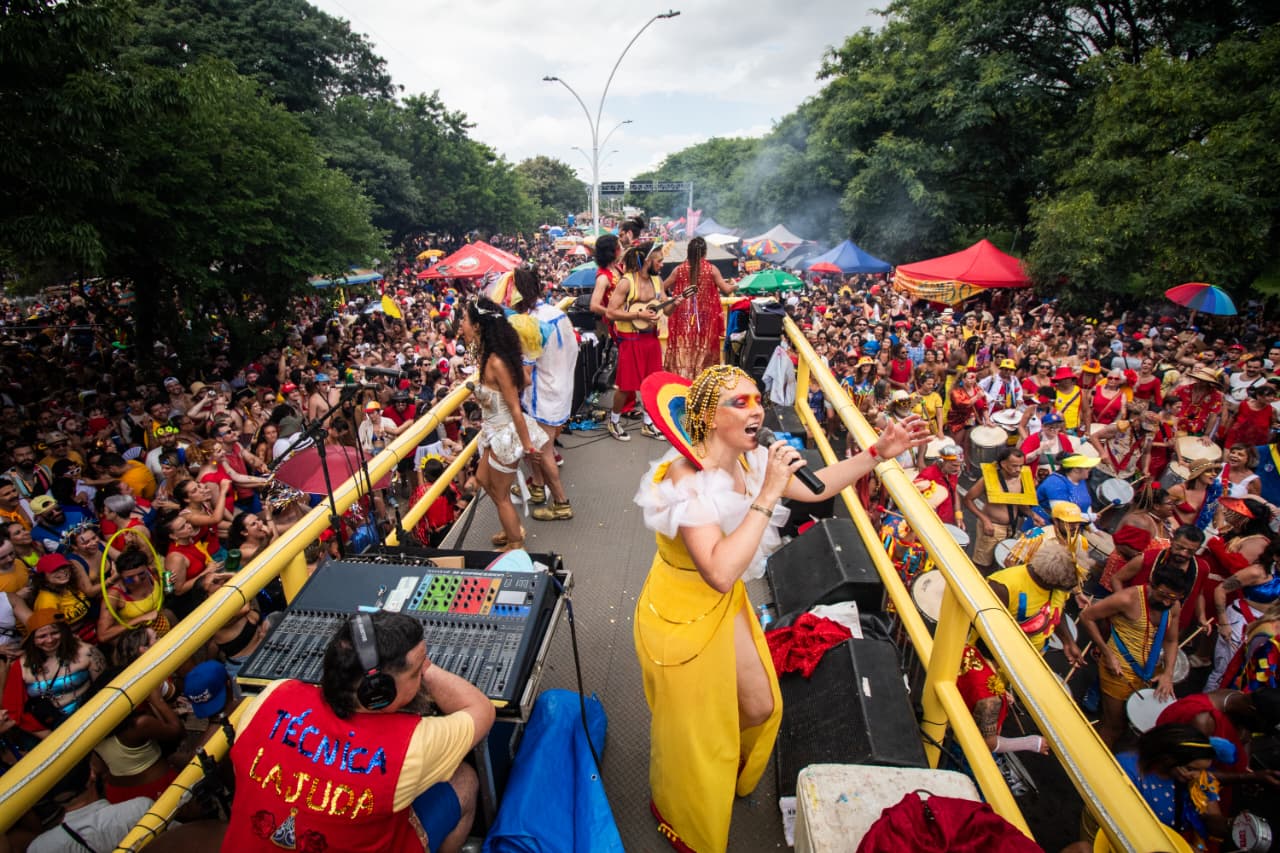
Martina is one of the “cantantes” (singers) of the group. Photo by: Thales Renato
For those who look at her right now, wearing yellow, red, blue, and a smile, it is impossible to say that she was once a shy and introspective child. This Martina, known as “the sun” by Bloco da Laje’s core members, however, was born together with the block. It was at the end of 2011, when some friends from Porto Alegre’s theater scene decided to use the town’s streets and parks as their carnival stage. Having participated in street carnival parades in Rio de Janeiro that same year, the group brought back in their luggage the desire to replicate the idea in their own way in the southernmost capital city of Brazil.
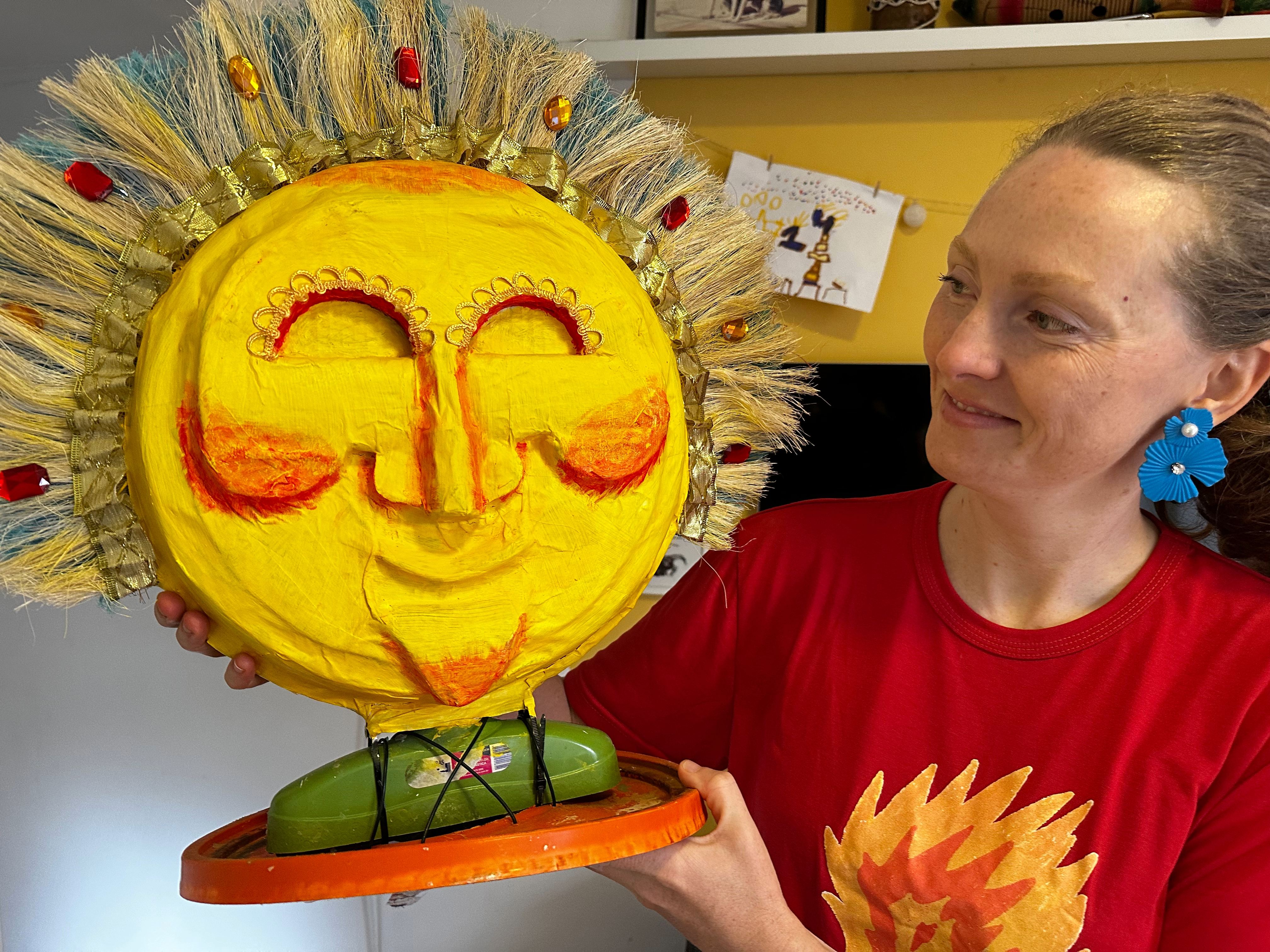
Martina holding her symbol: the sun. Photo by: Adriana de Souas Figueiredo
At that point, the country was experiencing a crescendo in the carnival street block initiatives. Worldwide, the Occupy movements represented a trend as well. From this political-artistic combination, Bloco da Laje was created, intending to occupy public spaces and reclaiming the right to the city, as explained by Martina, one of the founding members of the group. Their first parade was on February 12th, 2012, before that year’s carnival, and already gathered more than a thousand “brincantes”, as the block’s revelers are called. Since then, every year they have chosen different places in town for their parades, always looking forward to a theatrical dialogue with the particularities of each space.
The concept developed by the group for its identity was very simple: to wear the colors blue, red, and yellow, which instantly made it easy to tell Bloco da Laje apart from the few other blocks in the city. As recalled by Martina, the palette was chosen spontaneously by a colleague, without a clearly defined symbolic intention. Along with it, there was the idea of doing it yourself when it came to costumes and characterization. This whole idea was completely connected to their name. While “bloco” means “block”, “da Laje” refers to a kind of rooftop, but less fancy, particular to the Brazilian reality. The direct translation is slab, and it represents the space in houses and buildings, above the roof, where family and friends gather to roast a Sunday barbecue or to enjoy the sun in a beach chair together. In summary, it is a humble place for assembly and shared joy, where everyone is welcome.
Martina, too, helped to create the conceptualization behind Bloco da Laje, but she actually did not know much about carnival back then. A theater person herself, by chance and by professional choice, child of artists, she was raised within a German-Brazilian community in Rio Grande do Sul state, where carnival was not a tradition. Her artistic vein had been developed, over and above the theater, by singing in the Expresso 25 choir and playing, during her graduation, in the Maracatu Truvão musical group, which performs maracatu, a traditional cultural manifestation from Northeast Brazil. Only in 2008, in her twenties, did she have her first experience with any carnival movement. For reference, in Brazil, people are generally introduced to carnival celebrations already in their early childhood, bringing this tradition with them into adolescence and adulthood. For Martina, it happened later on. Since then, however, curiosity aroused inside her, just to find all the answers she sought in a group dressed in the primary colors: Bloco da Laje.
It is reasonable to say that both she and the block were lucky to have found each other. Since the beginning, Martina has been determined to help the group with everything she could. From her maracatu experience, she brought her shekere, a shaking instrument, which could be the inverted version of a rattle. Her participation in the choir encouraged her to be one of the “cantantes”, from the verb “cantar”, which means singing, the people responsible for singing. As it was not enough, she offered to sew the block’s flagship, which is still in use nowadays, simply because she had a sewing machine at home. The engine had belonged to her grandmother, who was a sewer, and was passed on from generation to generation, along with the sewing knowledge, which Martina sometimes applied to build theater outfits and allegories.
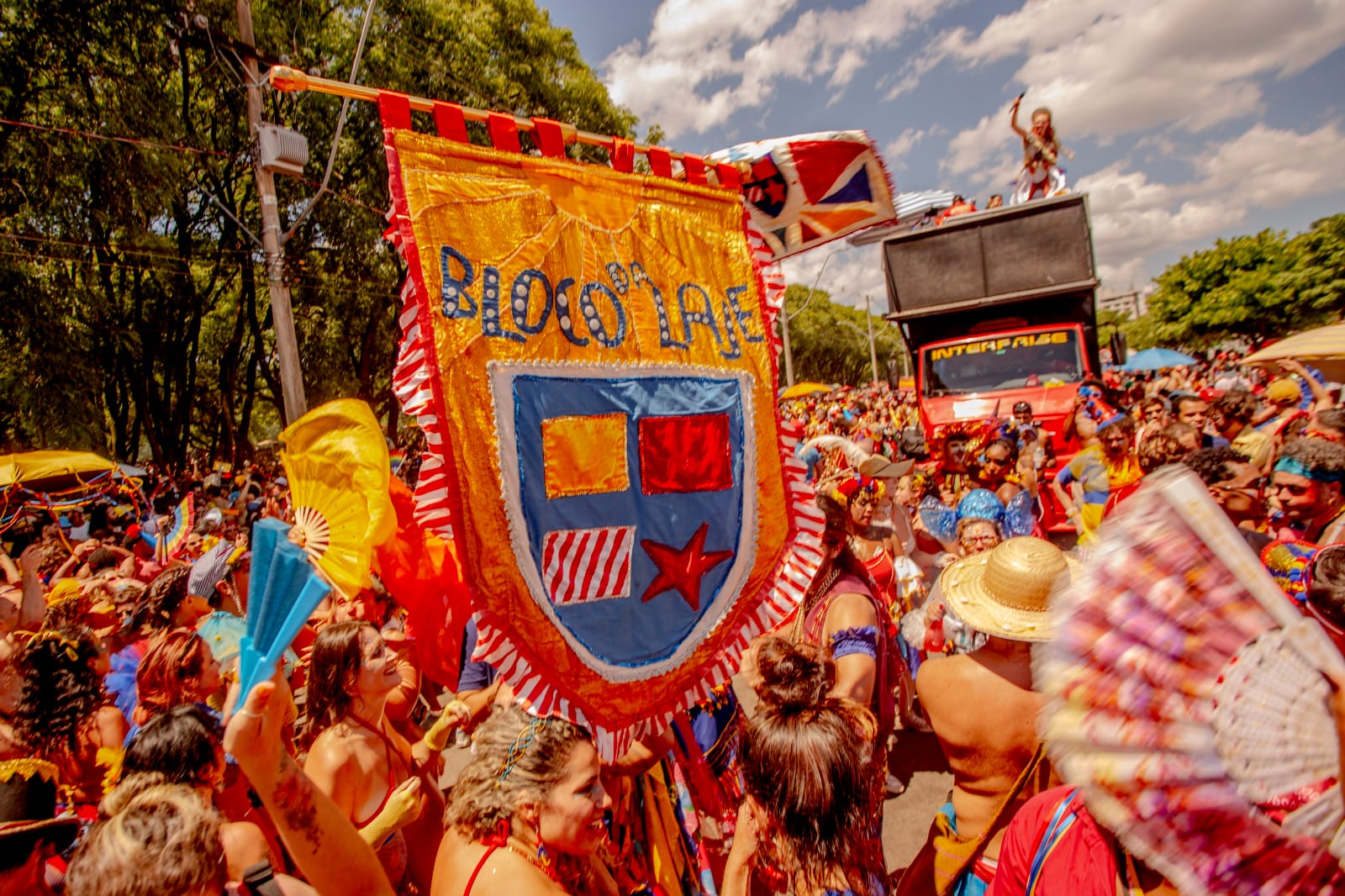
Bloco da Laje's flagship is always present at the parades. Photo: Rafael Morais
On the same night that Martina sewed the flagship, she created her costume for the parade, which was happening the next day. Because of the block’s song, she chose the sun as her character. “So I took a blouse that I had, covered it in yellow, and made a crown out of cardboard, with some glitter, and covered it with fabric. A proper improvisation”, Martina comments. She did not know it yet, but that night she was also sewing a new identity for herself. The sun represented the vibrant, confident self that had begun to emerge within her, a brightness she now felt ready to share with others. “It was also a choice I made because of the arts, in general, and the block, in a very special way, for it was a place for arousal and blossoming, very strong for me.”
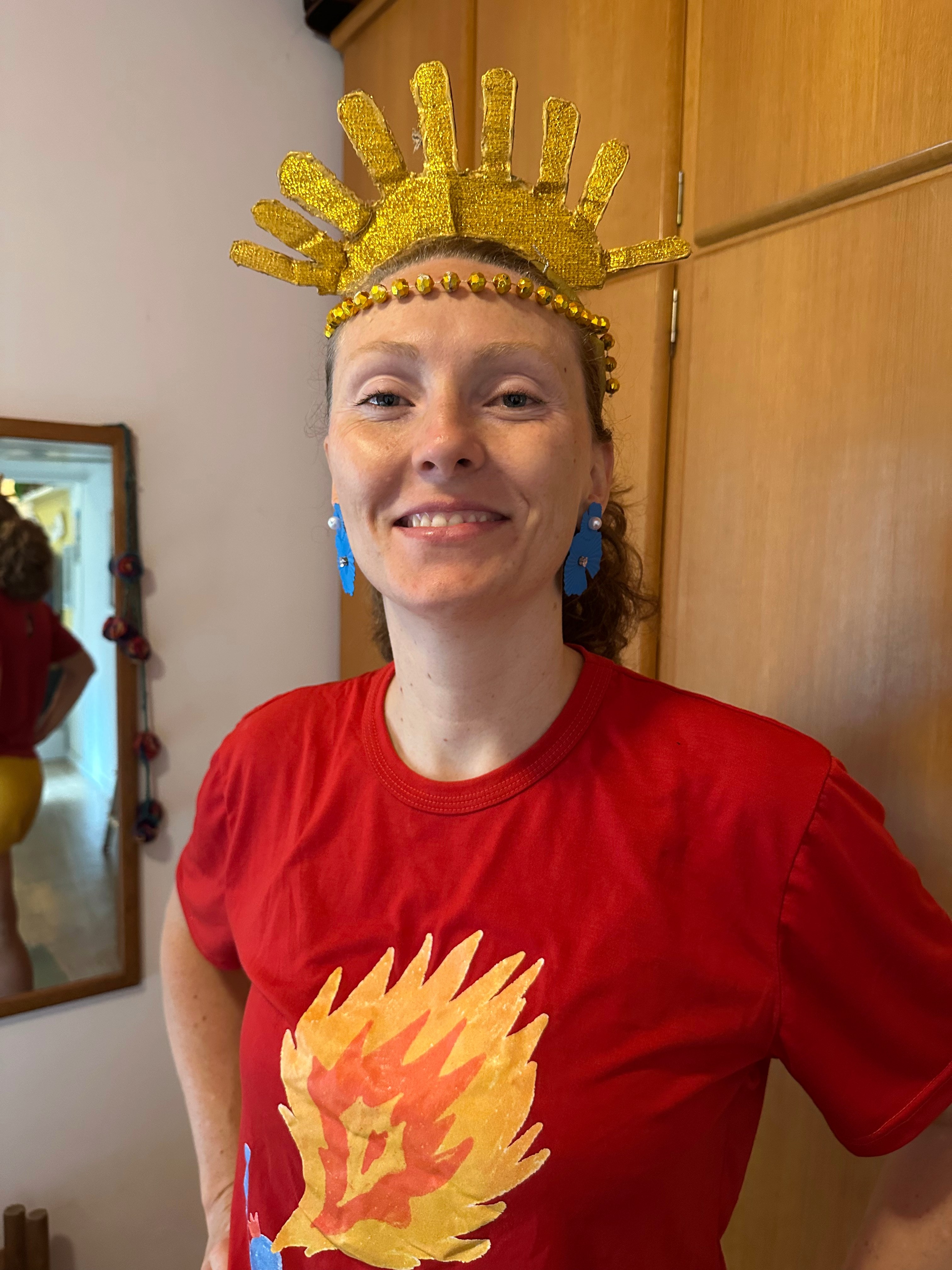
Martina keeps her first sun costume to this day. Photo by: Adriana de Sousa Figueiredo
She was not contented, however, with giving life to a personalized costume only for herself. In the block’s shack, where all the allegories and outfits are made before the parade, Martina and her sewing machine started transforming others’ dreams into reality. “I asked the participants to bring donations of materials from what they had at home. I made a list with the colors and cotton fabrics that could be dyed with the colors [of the block], trims, buttons, scrap.” Everyone who arrived would ask her what they could use as a costume, while she showed them the infinite possibilities contained in their community’s acquis. After all, besides the costumes, a participatory environment was being created in those exchanging moments. “It is not only about the clothing. It is also a creative process of characters’ building”, emphasizes.
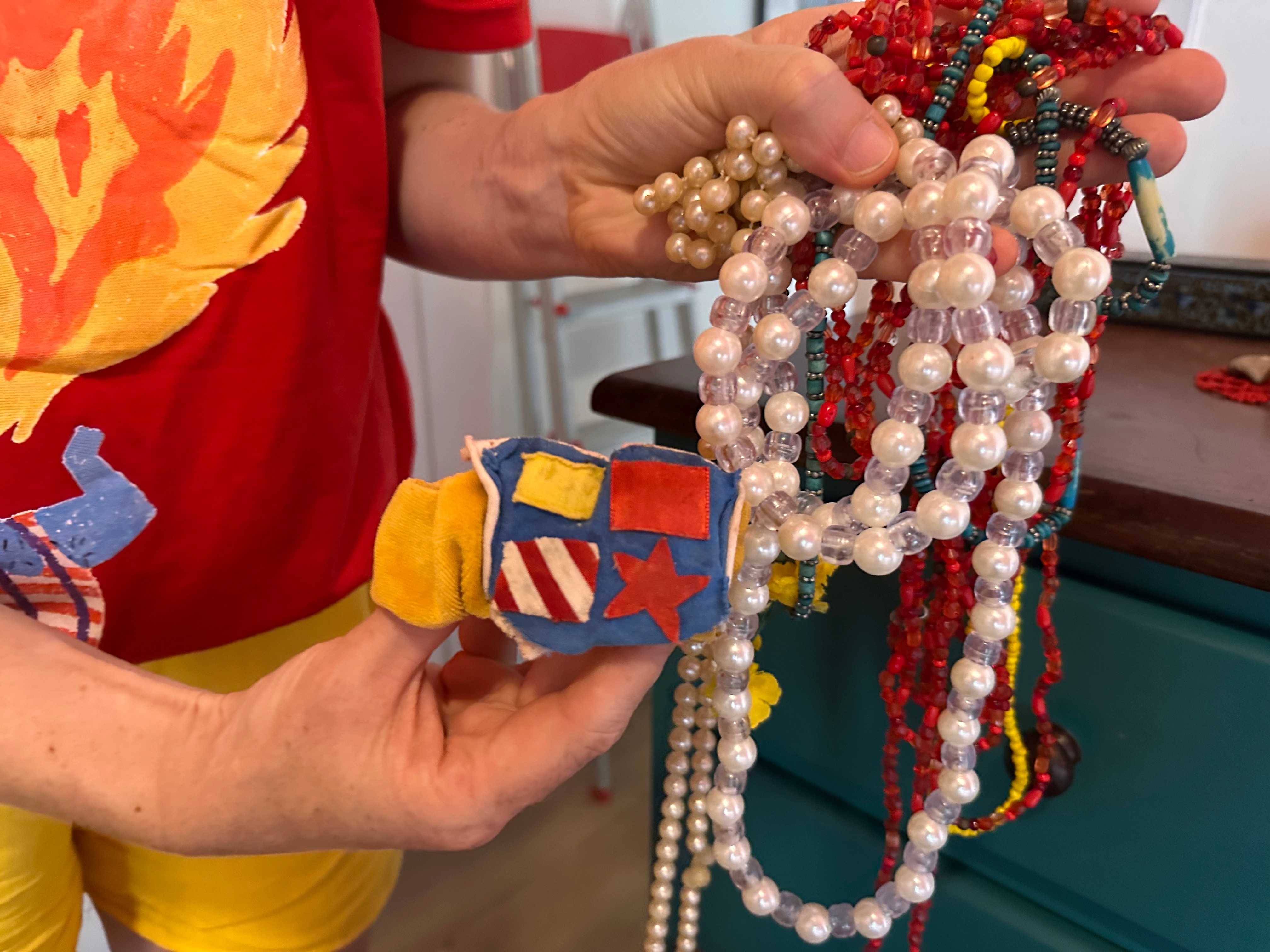
Bloco da Laje accessories and costumes serve as a memento for Martina. Photo by: Adriana de Sousa Figueiredo
That is how the so-called improvisation aesthetics has been shaping eye-catching, flashy, and unique carnival costumes. This same aesthetic has also shown itself to be inclusive of everyone, because the beauty of the outfits is not once related to how much they cost or how new they are.
As highlighted by Martina, “the carnival has this characteristic of the costume. The costume is not only about wearing a piece of clothing or a character. It is about your dream, your desire, what I want to be, what I want to represent, what I want to play the lead in.” It is precisely this dimension, the costume as a way of embodying a version of oneself, that also resonates with Martina’s own experience within the block, where choosing a character – the sun – became a way of giving shape to an emerging sense of self.
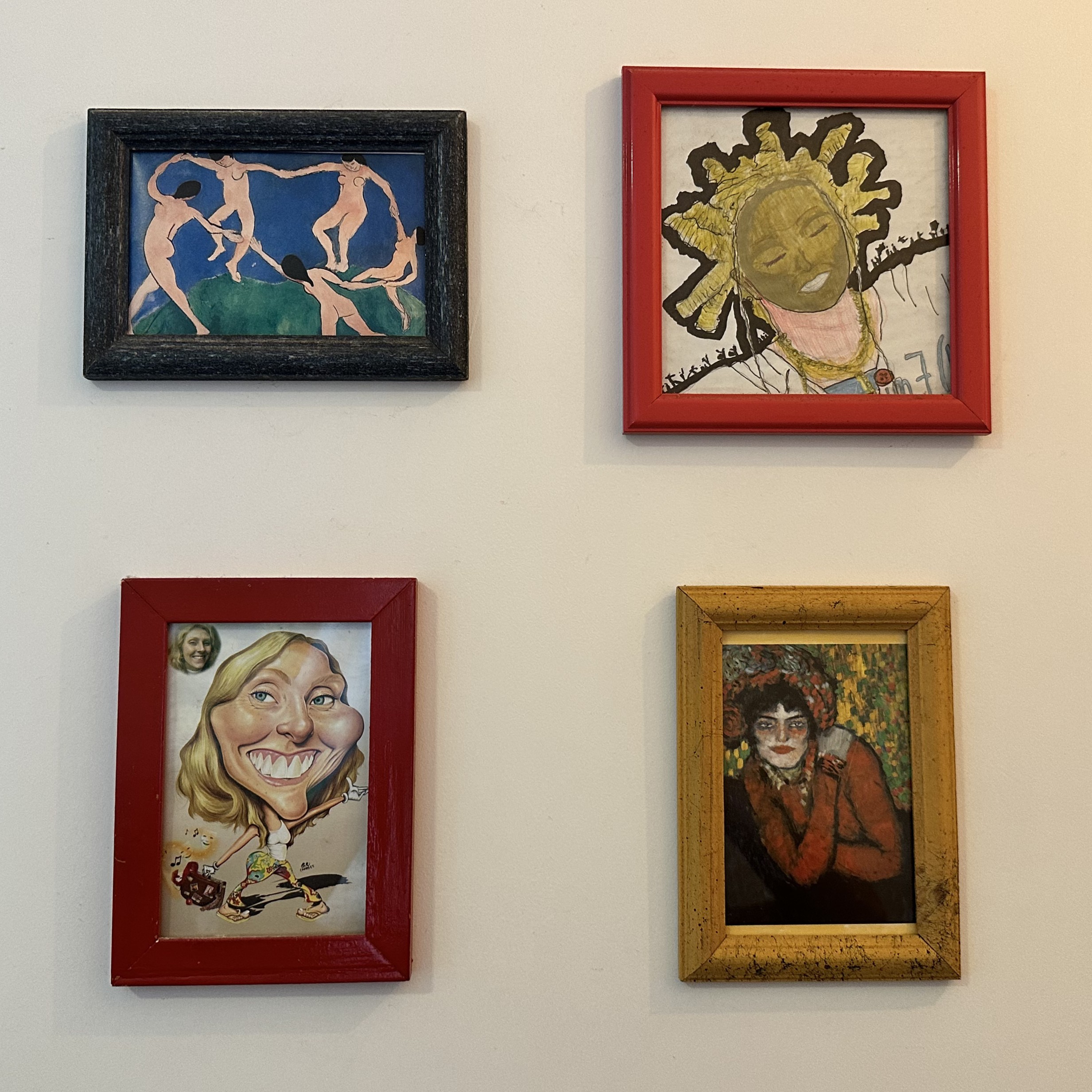
Martina’s house is adorned with Bloco da Laje-related objects, such as a drawing representing her as the sun. Photo by: Adriana de Souas Figueiredo
In the Bloco da Laje play, everyone is invited to be whoever they want. Like in a dramaturgical performance, the group creates scenes and playful moments, and connects them to stories of the city. “We usually say that our joy is our resistance”, explains Martina, alluding to the broader political and social constraints that often limit how people can occupy and experience public space together. “So, even though it is more like a huge play section, it is carnival, we say that our child’s play is a serious play, because it speaks about citizenship.”
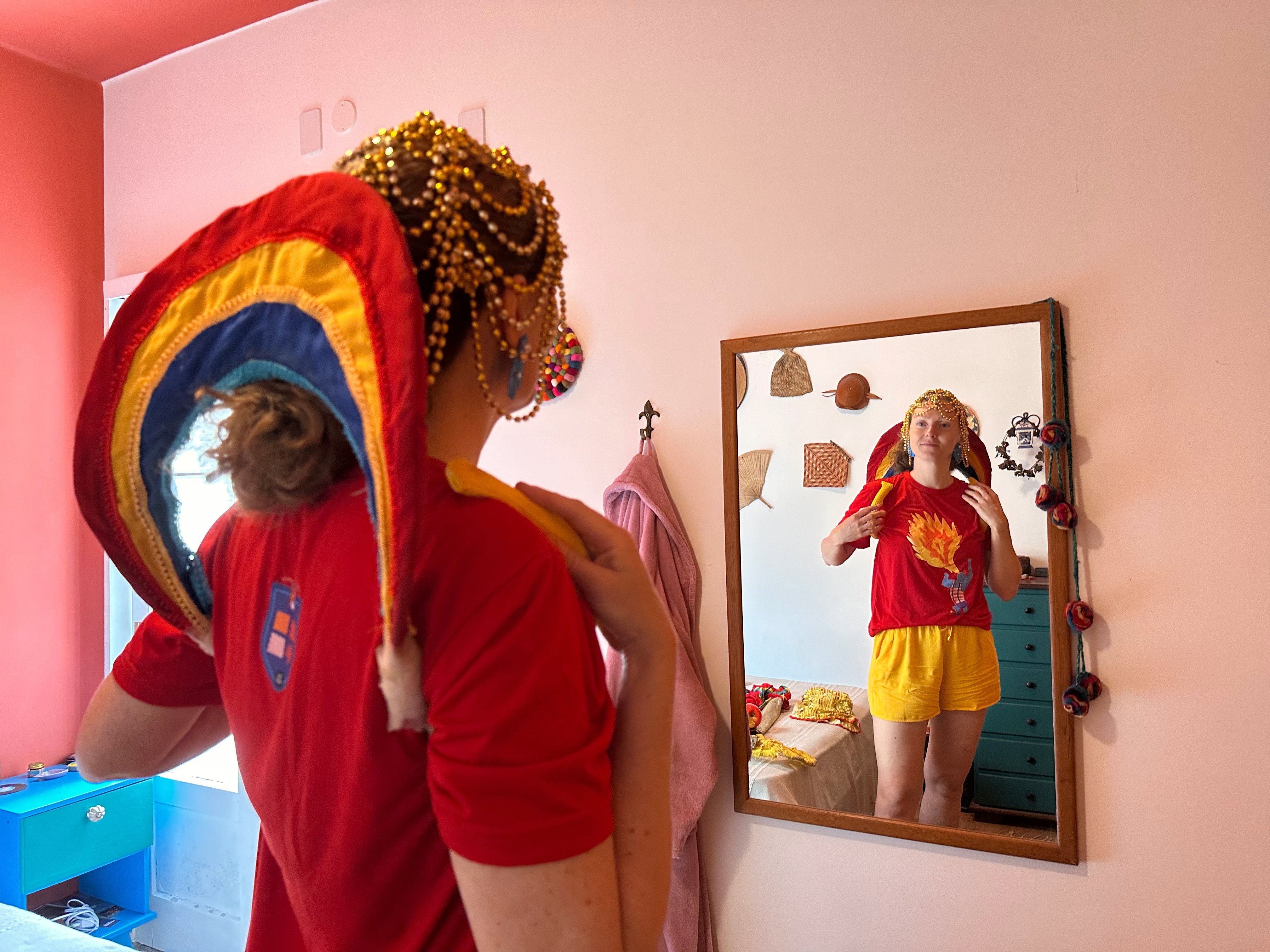
Martina proudly shows one of her many handmade versions of the sun’s costume. Photo by: Adriana de Souas Figueiredo
In everything they do, affirms Martina, there is a touch of artistic care, without forgetting their reason to be. At every Bloco da Laje event, the purpose of reclaiming the city in a playful way echoes through Porto Alegre streets in songs infused with political meaning, especially addressing citizenship, public space, and collective belonging, a message that is loudly reinforced by some 20 or 30 thousand citizens dressed in blue, yellow, and red.
Diesen Beitrag teilen via:

Adriana Figueiredo
Adriana Figueiredo, 1996 in Porto Alegre, Brasilien geboren, hat schon immer gern ihre Gedanken geteilt – mal laut, mal leise, aber am liebsten schriftlich. Getrieben von dem Wunsch, die Welt ein Stück besser zu verstehen und Missstände sichtbar zu machen, fand sie im Journalismus das passende Werkzeug. Seit 2024 lebt sie in Deutschland, ist Mitglied eines Buchclubs und singt in einem internationalen Chor. Als begeisterte Reisende hat Adriana bereits rund 20 Länder besucht – und plant mit großer Wahrscheinlichkeit gerade ihre nächste Reise.