
The Sisterhood of Burda Magazine: How poverty and resilience shape personal style
Women across the globe are connected by shared stories and the desire to express themselves through fashion. Different experiences, yet similar memories, come together in the power of self-made clothing and personal style.
It has been cold and gloomy since the beginning of December, and people have settled into their winter jackets, nothing unusual for Germany. But not everyone, a lady walked into the cafeteria of the international broadcaster company DW Bonn, wearing a black summer dress, Converse sneakers, and holding a checkered shirt in her hand. As I sipped my daily coffee in the vast white hall, where grey chairs and white tables stood in rigid rows, and low lamps flattened the light. I peeked through the lamp to see her: a sleek dark bob, statement burgundy glasses, ruffled short sleeves, and a vest embroidered with motifs; at the center bottom of the vest, a woman figure with what appeared to be the Tree of Life blooming from the top of her head.
It was not the first time Yulia’s outfit had caught my attention during my usual visits to the cafeteria between my classes at DW. Amid what I could only call boring outfits, hers had always felt like a piece of art. We first met 2 years ago during my orientation weeks in the broadcaster, during a media literacy workshop, and ever since, I have been noticing her outfits, so I decided to finally ask her how her sense of style had evolved, curious not only about the outfit itself but also what it revealed about her as a person.
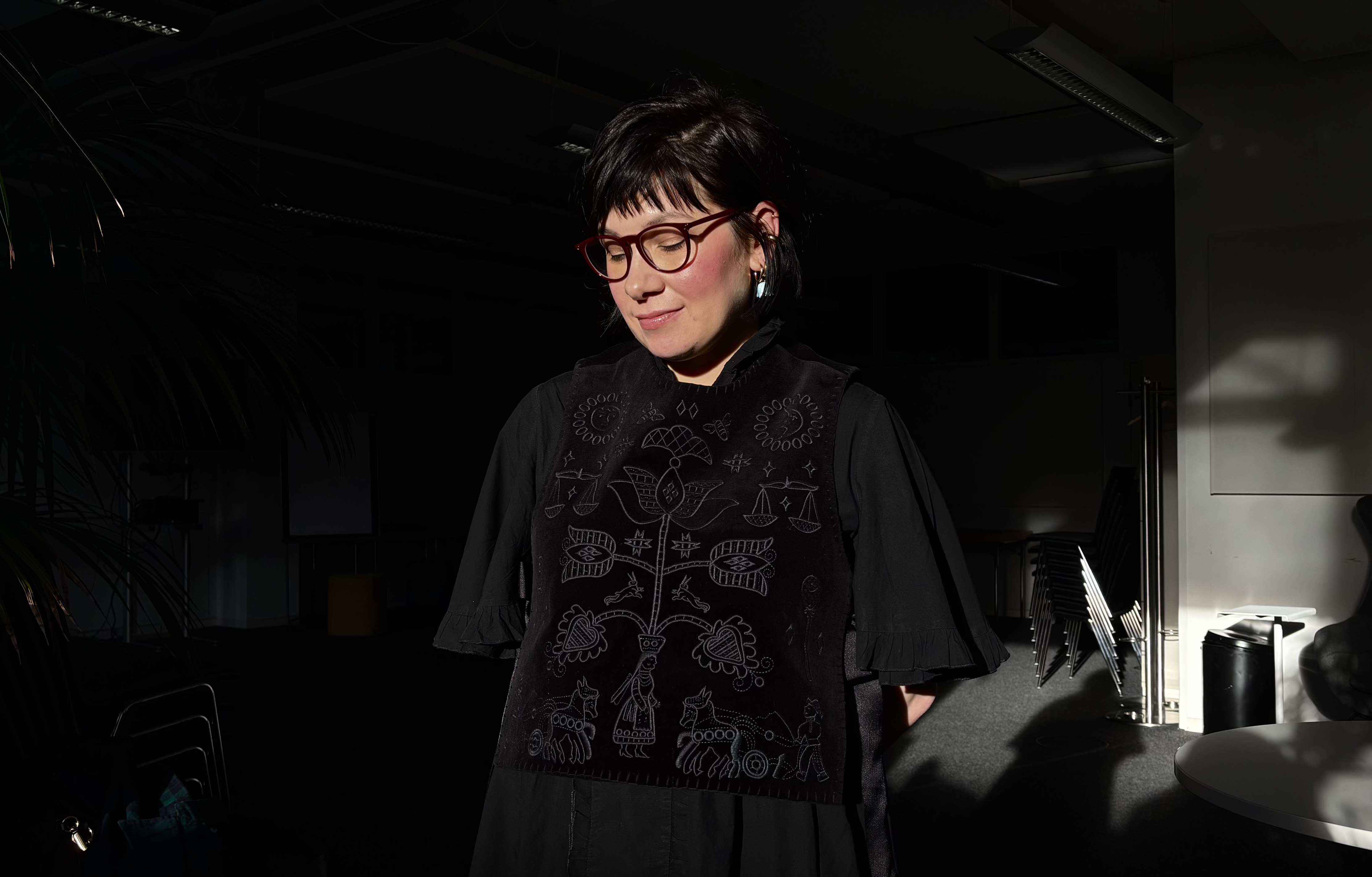
Photo by: Mariam Elbaz
When I looked closely at her while we were talking, I noticed the golden earring on one of Yulia’s ears sparkling in the warm winter sun, which she described as a Ukrainian lady in a traditional Ukrainian garment when I asked her about its meaning. „It’s from a Ukrainian brand called ‚Gunia‘”. In Ukrainian, the word Gunia means a traditional handcrafted wool coat. „The brand started with making traditional fur coats, and now they have their jewelry line.“
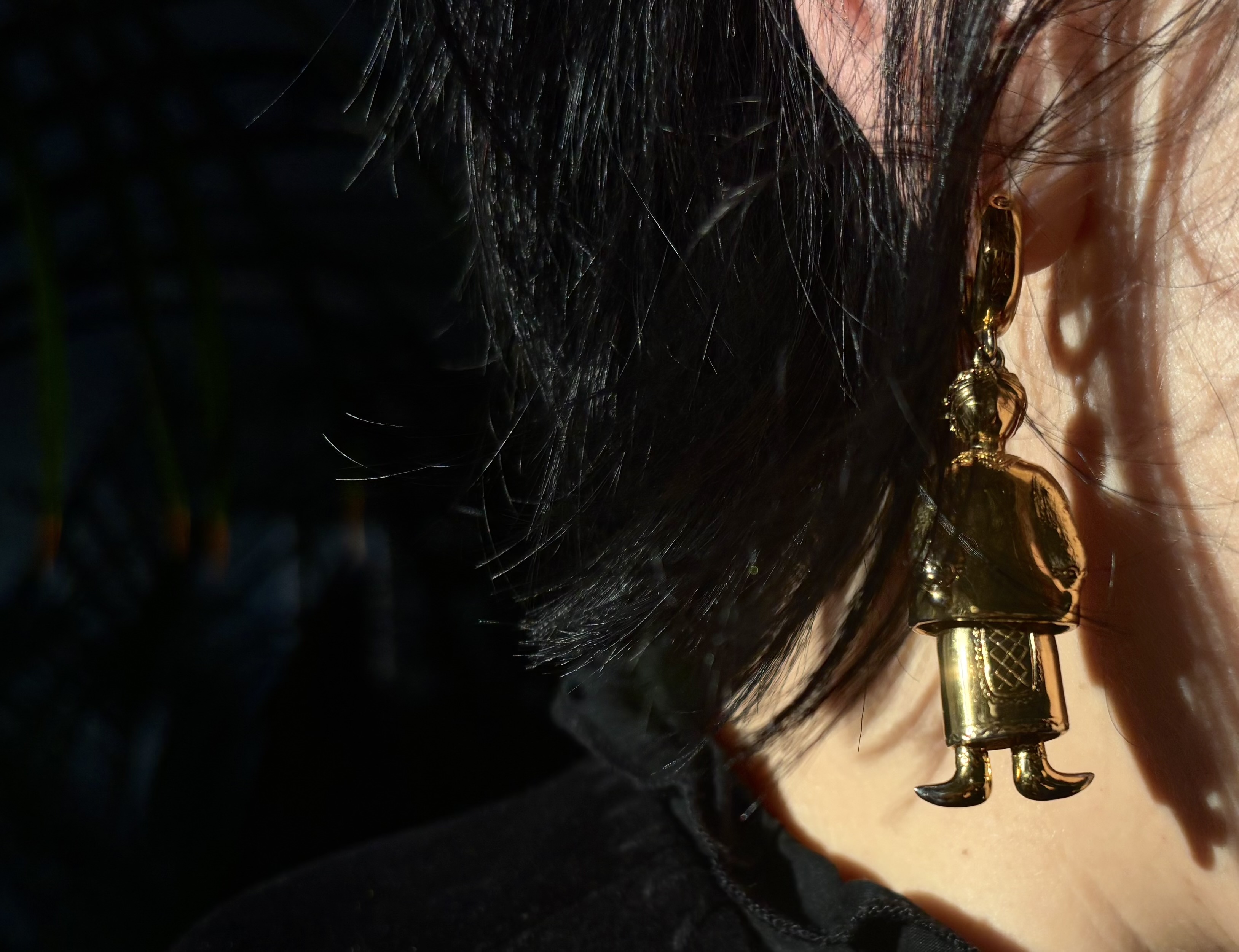
Photo by: Mariam Elbaz
Yulia manages a media and information literacy program for Ukraine, working on educational initiatives and AI-based tools for newsrooms. „I’m a facilitator. But I like the word enabler because I help teams come up with different products.“
She is half Tatar, a quarter Ukrainian, and a quarter Belarusian. However, she has always positioned herself as 100% Tatar until the full-scale invasion of Ukraine by Russia started in 2022, which led her to define herself in a very specific way. „Now I usually say that I’m a Tatar with Ukrainian roots living in Germany.“
For a job that requires interacting with people from different contexts and countries, as well as moderating workshops, Yulia sees her clothes as her soft power. „Because when I go to events, as a trainer, people start asking me about what I am wearing, oh, wow, what is this? And this is my hook to start speaking about Ukraine.’ According to Yulia, people are so tired of discussing the war in Ukraine, and using commodities from local brands helps her in approaching them.“
I’m a facilitator. But I like the word enabler because I help teams come up with different products.
- Yulia
She chooses every piece of clothing carefully. „For example, I have one dress, it was made in Odesa, a city in the south of Ukraine, near the sea, and it’s being attacked now. I wanted to support them during the first year of the full-scale invasion.“ When she received the dress, it did not suit her perfectly, but to her, this dress was more than just a piece of garment; it was produced during blackouts and scarcity of labor, it was a symbol of the tough situation in Ukraine, which continues at the time of writing this article.
Growing up in her hometown, Yulia had to share clothes with her sister. Until primary school, she had to wear a uniform, but then something changed when she switched schools, and there was no longer a mandatory uniform. „I think I was 10. And that was the first time I realized that I’m very poor. Because everybody else had his or her clothes.“ This was when Yulia felt like clothes mattered to her for the first time, and it could determine whether other kids think she is cool or not. „But then my mom suggested sewing clothes for me using a fashion magazine … I don’t know if you know this magazine, it’s called Burda Moden. Have you heard of it?“
That was the moment when we discovered another connection together, an unexpected one between Ukraine and Egypt, the country where I grew up. „Yes, both my mom and grandmother had stacks of Burda magazines, but finding them wasn’t easy. From the way they described it, it sounded almost like a smuggling operation, tracking down the few dealers in Cairo and Alexandria who stocked them and hoping you’d get lucky.“
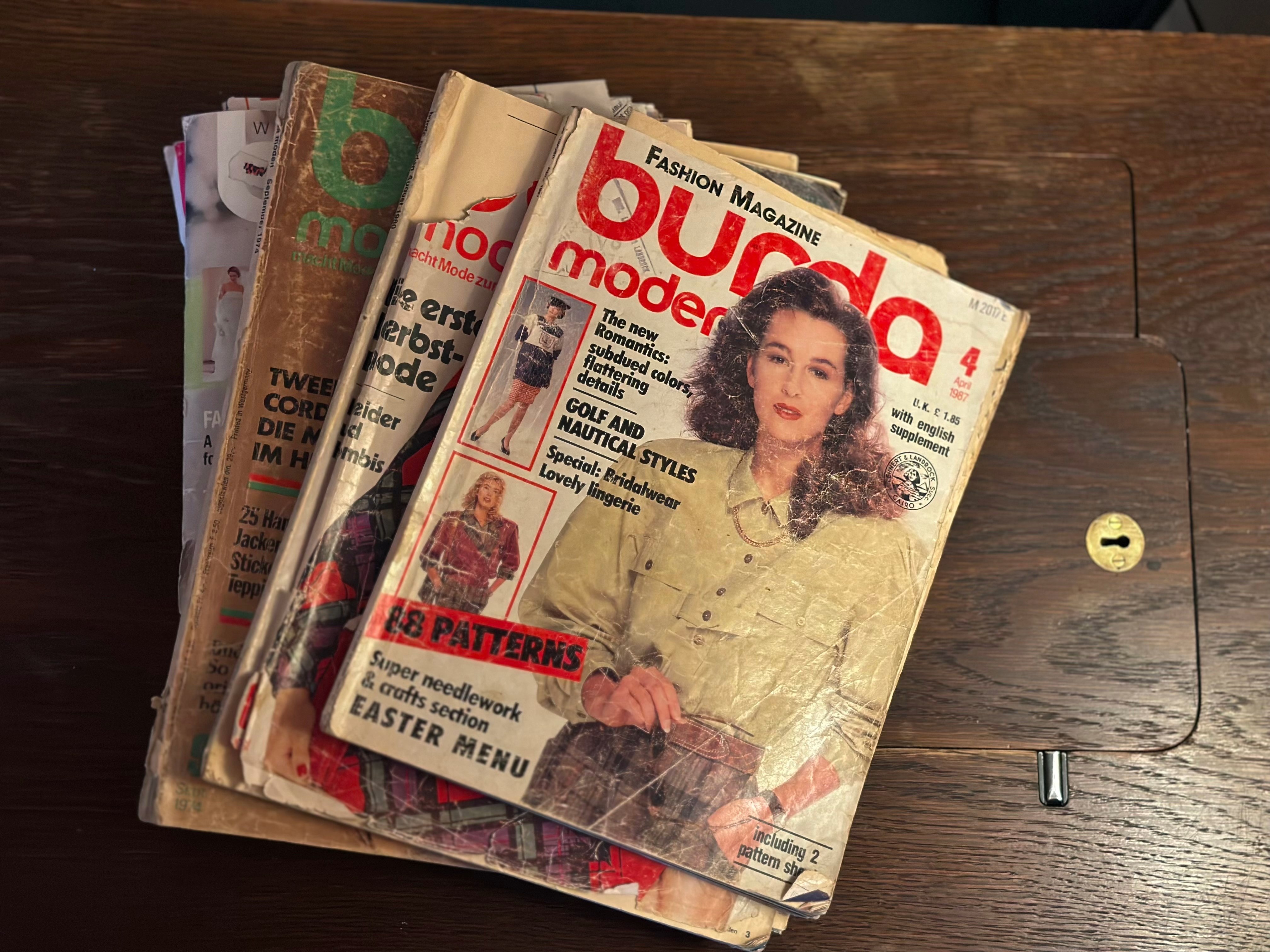
Photo by: Mariam Elbaz
After speaking with Yulia, I called my mother in Egypt to tell her about Yulia’s story. She got excited and said, “I could relate very much.” Almost all of my mom’s clothes as a child were sewn by her own mother using Burda magazine. She even mentioned one swimsuit, a two-piece decorated with flowers, fastened at the sides with ribbons, which was inspired by one of the swimsuits in the magazine.
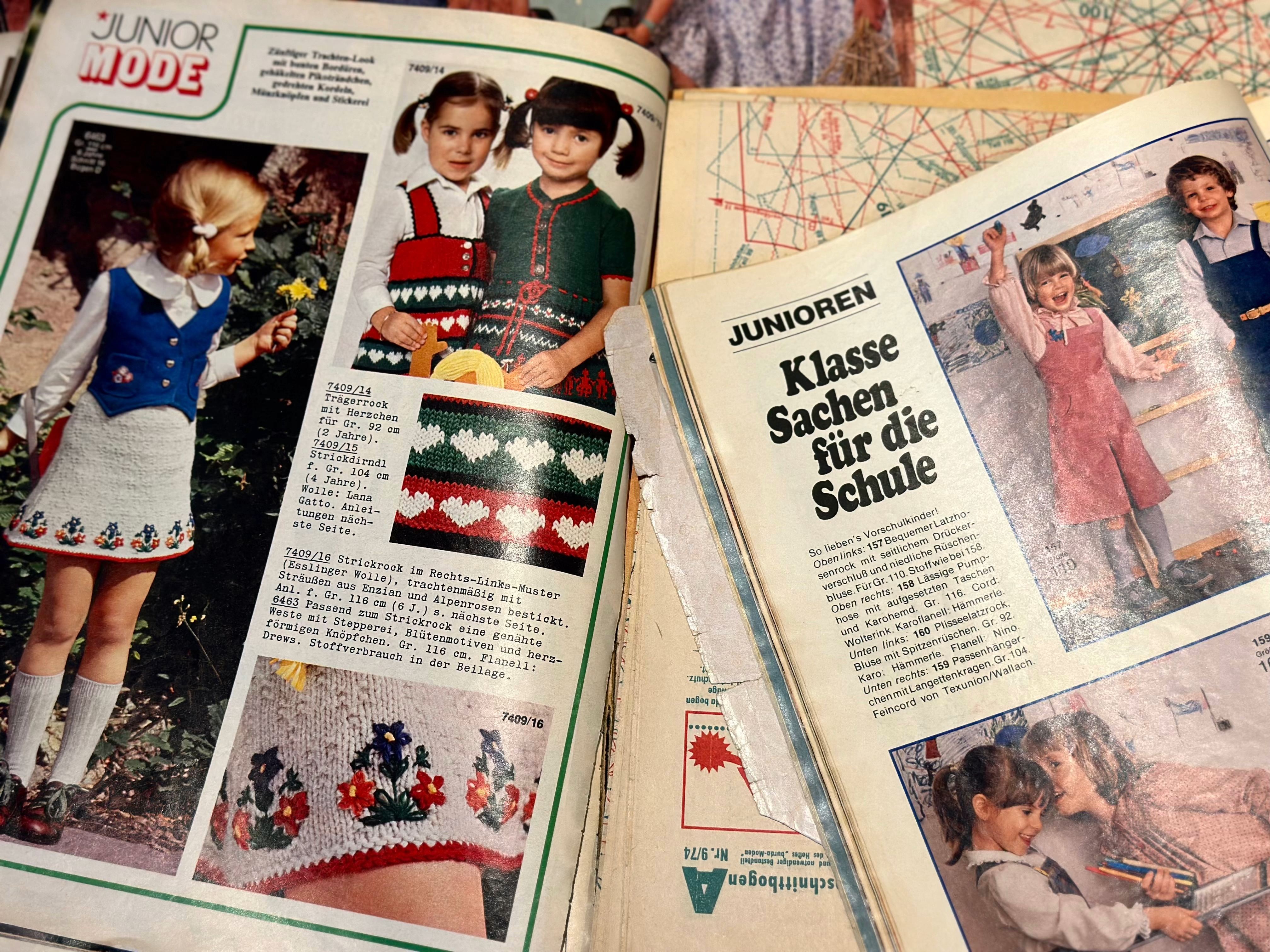
Photo by: Mariam Elbaz
This new world of DIY (Do it yourself) fashion – back then more than a trend but born from necessity – has changed Yulia’s life. Together with her sister, mother, and aunt, she created a paper wardrobe, filled with hand-drawn dresses and accessories they made themselves. Thus, a paper wardrobe is a fashion universe made entirely of paper—miniature dresses, coats, and entire collections imagined, cut, and styled on the page. „So, somehow this poverty turned into, let’s make our clothes“, Yulia said. One day, she was wearing one of her creations from the paper wardrobe; an electric blue dress with a pink sweater on top, when an adult said to her that she looked very eccentric. „I remember being like, no way, why? But then I thought, well, yes, I’m this weird person.“
Yulia shares her thoughts about how clothing can change the way a person is perceived. „I can be super-centric, less-centric, strange person, crazy person, pain in the ass person, rebellious person. But then I can just sit in my apartment, be calm, and work.“ Her answer reminded me of a sentence in an old Burda magazine where self-made clothes were described as a way to decide how one wants to appear in the world.
Back in the day, during Yulia’s childhood, fashion magazines used to contribute to the making of fashion trends; it was people’s interpretation of the designs they offered that helped shape those trends. Those who sewed themselves developed a sense of their figure, measuring and feeling the fabric, and noting how colors worked with their skin; it was a very personal journey.
I think I was ten. And that was the first time I realized that I’m very poor. Because everybody else had his or her clothes.
- Yulia
Today, social media shapes fashion trends. Studies show that platforms act as “digital runways,” spreading styles at unprecedented speed and inspiring consumers through influencers, personalized recommendations, and peer content. I was curious to know Yulia’s perspective on this: „I think social media is like a trap, we think that everybody has this item or that everybody is into purchasing this item, but actually in real life nobody cares.“
When she looks at Eastern European women on Instagram, especially in Ukraine, she notices how interested they remain in fashion despite the war. “Maybe it’s one of those coping strategies. There’s a war, bombing, and drones all night, but the next morning, I have to go back to my life. [and] fashion is one of those tools [that] brings a sense of normal life [and] something you can have control over.”
Yulia points to her other golden earring with white and navy blue. “This one is a poppy flower.” She had bought the same earrings for the women mentors at an event in Ukraine. They were strangers to her; however, by the end of the event, the earrings had done more than decorate, they had sparked conversations and woven a network of connections across the room.
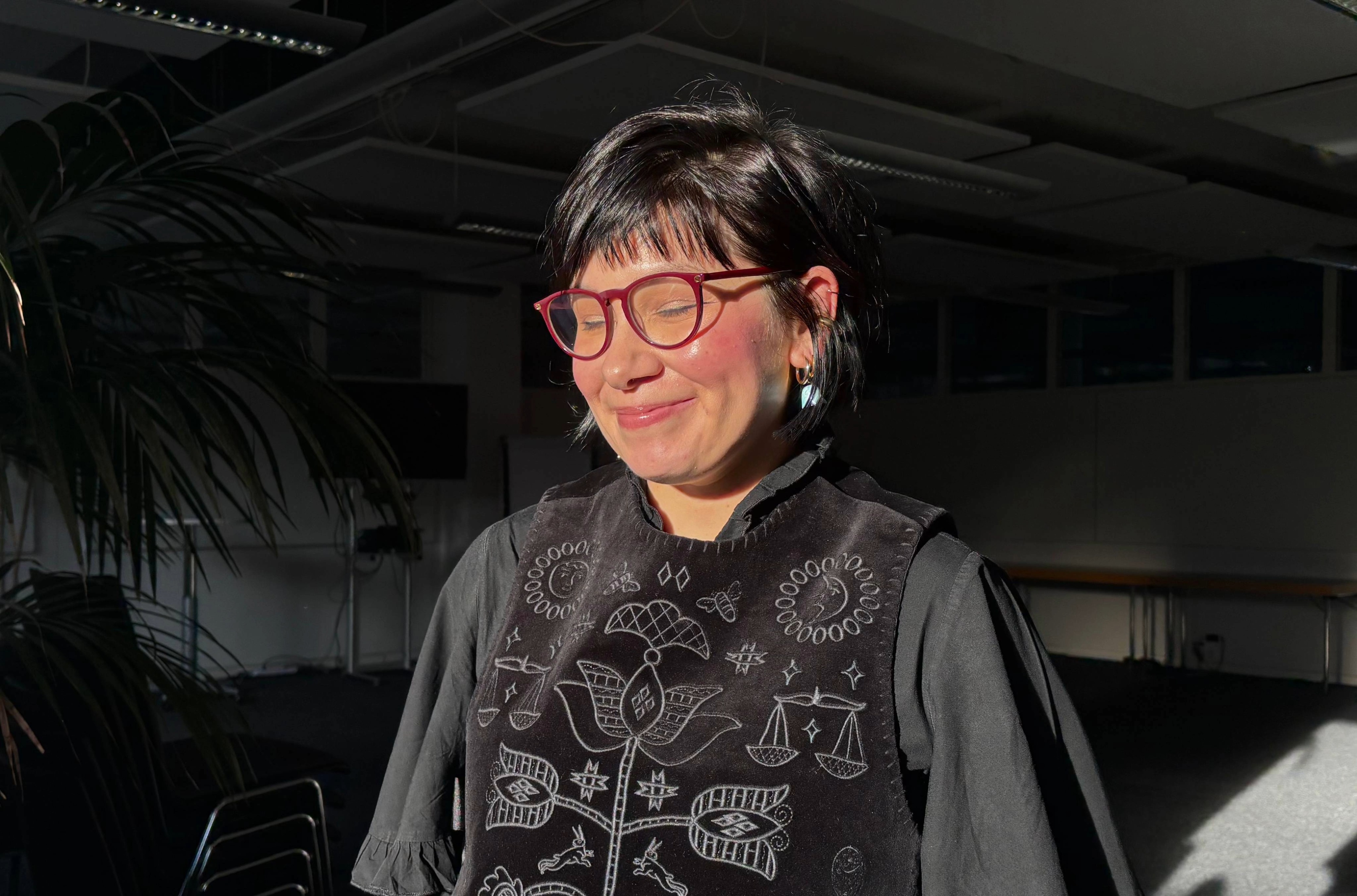
Photo by: Mariam Elbaz
Yulia doesn’t follow a recipe, nor does she care about the weather. Her inspiration comes from trying, people watching, and, of course, some of her favorite brands on social media. If she wakes up feeling like wearing something, she will, and it will most probably look like she’s going to a Vienna ball, despite living in Germany. Over the years, she still thinks of herself as this weird person with a rebellious style. “If you want to be brave, start with clothes. Experiment more. If you think you’re not too creative, experiment with clothes. I think clothes are the best place to start. You can train your creativity like a muscle.”
This thread of recurring challenges, shared by women like my mother, Yulia, and her sister, my grandmother, and even Yulia’s grandmother, left me wondering whether my connection to Yulia’s style came from recognizing a shared past between us. Later, when I realized that Burda is a German magazine and that we met in Germany, that curiosity deepened. It made me reflect on how women across the world are bound by so much in common, stories of resilience, creativity, and power. And what if we had those conversations with each other more often?
This article was produced as part of the International Media Studies master’s program at the DW Akademie.
Supervised by: Mira Keßler
Diesen Beitrag teilen via:
Mariam Elbaz
Mariam Elbaz wurde 1999 in Kairo geboren und verbrachte ihre Sommer am Meer in Alexandria. Mit sieben Jahren erhielt sie ihr erstes Tagebuch und begann, die Welt um sich herum in Worten festzuhalten. Dabei entwickelte sie ein Gespür für die Geschichten, die oft in den kleinen Dingen des Alltags verborgen liegen. Ihre Neugier auf die Welt führte sie zunächst in die Wissenschaft, ihre Begeisterung für Kunst und Kreativität blieb jedoch stets ein wichtiger Teil ihres Lebens. Heute sucht sie nach Wegen, beide Welten miteinander zu verbinden.