Communicating for Civil Protection: A Traineeship at the BBK
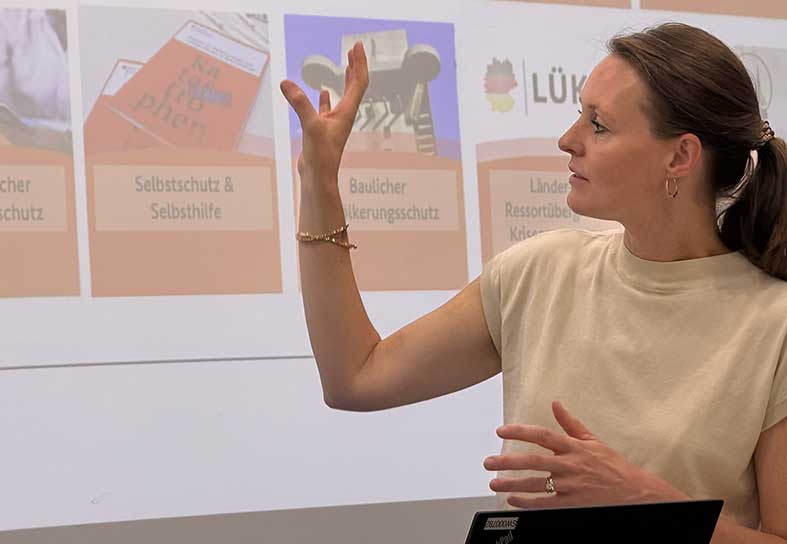
How does a federal agency communicate when its information is designed to help people prepare for crises and emergencies? The traineeship at Germany’s Federal Office of Civil Protection and Disaster Assistance (BBK) combines media relations, social media, and public communication with crisis communication of direct relevance to society.
The traineeship at the BBK offers an entry point into communications within the political and socially relevant environment of a federal agency. Unlike traditional corporate PR, the focus is not on promoting business interests but on providing the public with clear, factual, and targeted information. Speaking at an information session at Bonn-Rhein-Sieg University of Applied Sciences, Anke Moon, Head of Media Relations and Publications at the BBK, explained that the programme equips trainees with the skills needed to communicate with a clear focus on serving the public. It is, as Moon puts it, “communication made for people.”
From Websites to Specialist Magazines
Since 2004, the BBK has been Germany’s central federal authority for civil protection. In Germany, civil protection encompasses the federal government’s responsibilities and measures for protecting the civilian population in the event of national emergencies, as well as disaster management measures carried out by the federal states and municipalities. The BBK communicates with the population as a whole, with the aim of providing information, raising awareness, building trust, and strengthening people’s ability to protect themselves and take appropriate action.
The two-year traineeship is structured around a series of rotations, with trainees spending between three and six months in each of five different areas. These include the editorial team of the specialist magazine Bevölkerungsschutz, social media, website management, press relations, and internal communications. Practical experience is complemented by an external placement in public relations, internal and external training courses, and an independent project developed by the trainees themselves.
Team Coordination Is Essential
A mentoring system helps trainees find their way around the structures and procedures of a federal agency, with experienced staff introducing them to administrative processes. Trainees work in departmental teams of 15 to 18 people and have designated contacts who provide guidance in their day-to-day work. While they are expected to work with a high degree of independence, the responsibilities associated with public-sector communication mean that all content is subject to a two-person review process before publication. During the social media rotation, for example, trainees work on content creation, editorial planning, social media monitoring, and community management.
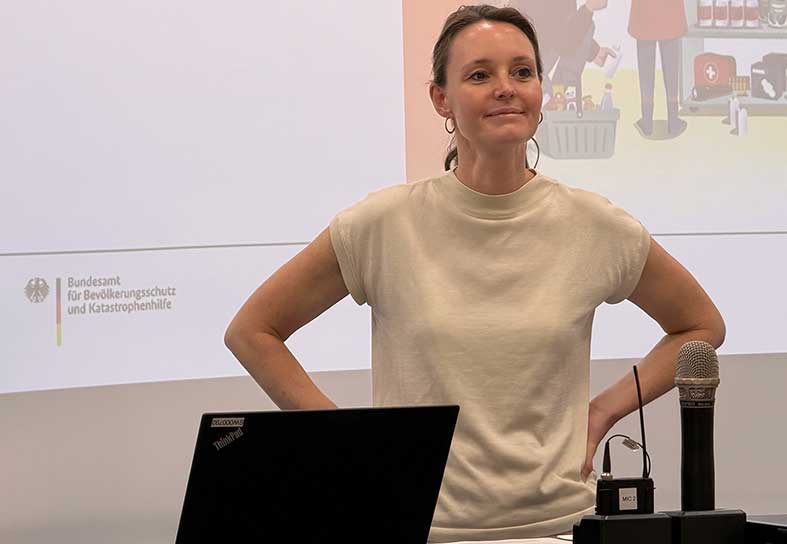
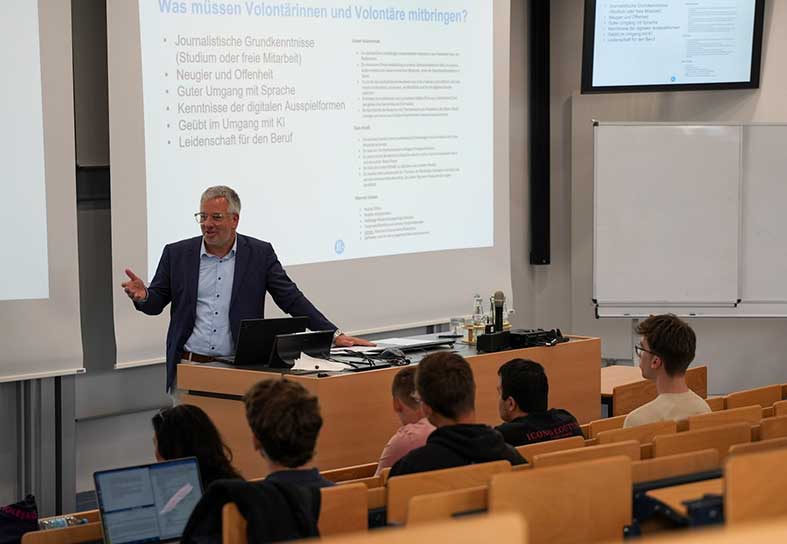
Anke Moon, Head of Media Relations and Publications at the BBK, during the information session at Bonn-Rhein-Sieg University of Applied Sciences. (Photo: Tabea Mansfeld)
The programme is aimed at graduates with a strong interest in political and public communication. A degree in communication studies or the humanities provides a suitable foundation. The BBK advertises between one and three traineeship positions each year on a staggered basis. Vacancies are published on the agency’s website as and when positions become available; there is no fixed annual application period.
Opportunities and Challenges at the BBK
One of the programme’s key benefits is the tangible impact of the work: the information produced by the BBK provides people with practical guidance on how to prepare for crises and emergencies. In addition, against the backdrop of a changing security environment, the BBK continues to expand its workforce, in contrast to staffing trends at some other public authorities. At the same time, there is no guarantee of a permanent position after the two-year programme, although the BBK aims to retain graduates where possible.
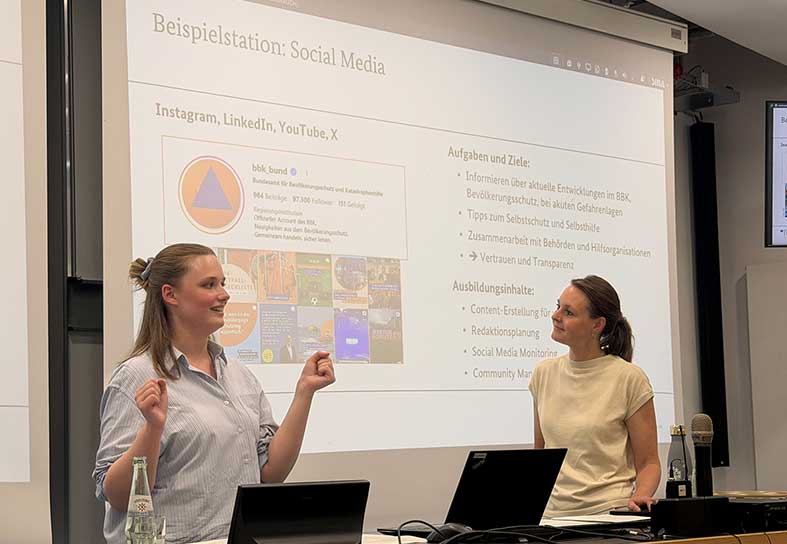
Anke Moon with a BBK trainee presenting the social media rotation. (Photo: Tabea Mansfeld)
Working at a federal agency also means navigating administrative hierarchies and coordination processes. After completing the programme, graduates may go on to work as press officers or public relations officers, in campaigns or crisis management at the BBK, or in social media management at other federal agencies or NGOs.
The BBK traineeship therefore provides comprehensive training in public-sector communications. It is particularly suited to aspiring communications professionals looking for a structured programme at the intersection of politics and public administration and who have a strong interest in communicating information relevant to crises and emergencies. Given the changing security environment and the resulting expansion of the BBK’s workforce, demand for qualified communications professionals in this field is likely to remain strong in the years ahead.