
Bringing Stories to Life: Training at the RTL School of Journalism
From regional newsrooms to international reporting assignments, the RTL School of Journalism prepares aspiring journalists for a career in the media through a combination of classroom teaching, hands-on experience, and cross-platform storytelling. At the heart of the programme is visual journalism.
Anyone looking to build a career in journalism with a strong focus on video storytelling will find a practice-oriented training programme at the RTL School of Journalism. Over the course of two years, classroom instruction alternates with a wide range of newsroom placements. According to programme director Simon Hof, trainees are encouraged to explore different areas of journalism, discover their strengths, and develop the skills needed for everyday newsroom life.
Combining Theory and Practice
The programme lasts two years, including around seven months of classroom-based training. The remainder consists of practical placements both within RTL and at external media organisations. Within the RTL Group, trainees work in a variety of editorial environments, including news programmes such as RTL aktuell, productions at RTL Studios, RTL Radio, and several production companies. Some trainees even gain experience on entertainment productions such as I’m a Celebrity … Get Me Out of Here!
External placements offer valuable insights into other news organisations, including Germany’s public broadcasters WDR and ZDF, exposing trainees to different editorial cultures and workflows. Many placements can be chosen according to the trainees‘ interests. However, some are mandatory. Early in the programme, all participants spend three months in a regional newsroom. They also complete a two-week placement with RTL’s verification team.
One of the programme’s highlights is the opportunity to undertake an international placement. Trainees can choose their destination themselves, with previous participants travelling everywhere from Mexico to the Australian jungle.
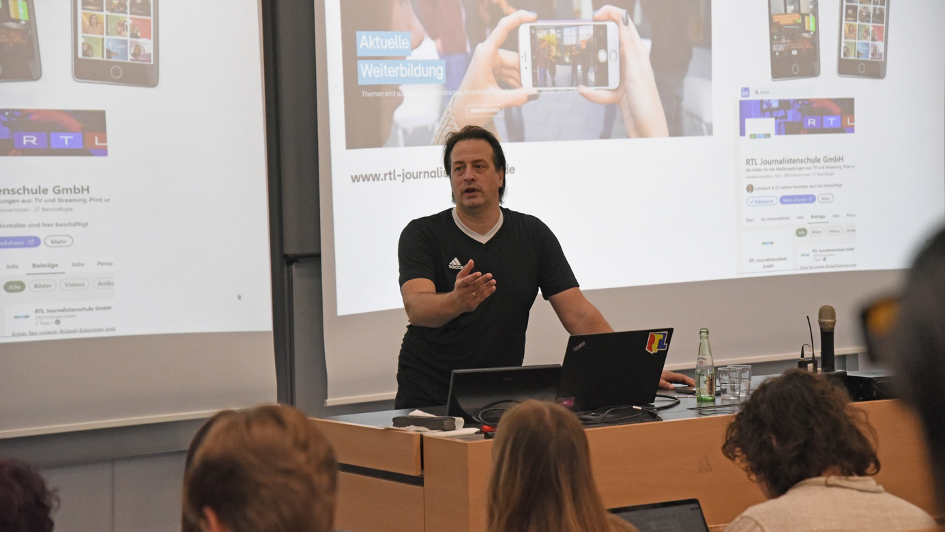
Simon Hof, director of the RTL School of Journalism at Bonn-Rhein-Sieg University of Applied Sciences
A Focus on Visual Storytelling
Video journalism is at the core of the programme. At the same time, trainees are prepared to produce content for a wide range of digital platforms through a strong cross-media approach. The curriculum covers storytelling, news formats, interviewing, reporting and presenting, alongside workshops on journalistic research and newsroom systems. Media law, journalism ethics, and quality standards are also integral parts of the programme.
Compared with many other journalism training programmes, RTL places particular emphasis on balancing theoretical instruction with practical experience, Simon Hof explains. At the same time, trainees are given the freedom to pursue their own creative ideas. In recent years, this has resulted in projects such as the podcast Gemischtwarenladen and the documentary „Sach ma Schalke“.
Who Should Apply?
The RTL School of Journalism is looking for people who are certain they want to become journalists and who enjoy telling stories. According to Simon Hof, curiosity, an interest in video production, creativity, and the willingness to contribute one’s own perspective are among the most important qualities.
Applicants must hold a German university entrance qualification (Abitur or Fachabitur). Previous experience in journalism or the media industry is an advantage but is not a formal requirement.
The school also places great emphasis on language skills. „Language is our raw material,“ Simon Hof says. Applicants are expected to be familiar with RTL’s programmes and journalistic output. While they do not need to enjoy every format, they should be open to the company’s journalism and media brands.
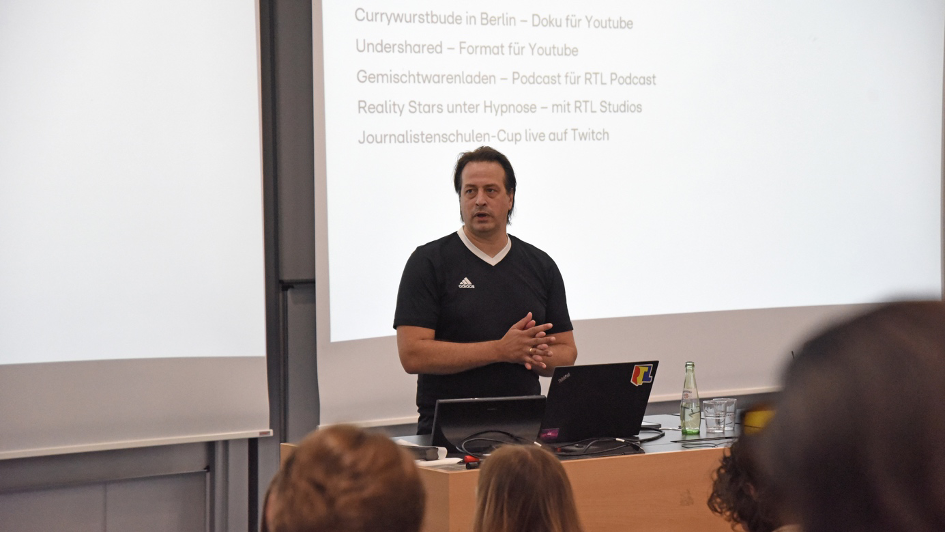
Simon Hof, director of the RTL School of Journalism at Bonn-Rhein-Sieg University of Applied Sciences
The Selection Process
Admission to the programme is highly competitive and takes place in several stages. The first round begins with more than 400 applications. Candidates write a feature story on one of three assigned topics and explain how they conducted their research. All submissions are assessed anonymously.
Around 100 applicants advance to the second stage, where they submit a CV along with a video application.
The final round brings together around 50 candidates for two assessment days. They complete practical journalism assignments, including producing a feature story, creating an Instagram Story, and taking a current affairs test. Personal interviews are also part of the selection process.
Every two years, only around 15 to 18 trainees are admitted. While the current cohort is completing its training, preparations for the next recruitment cycle are already underway. According to Simon Hof, applications are expected to open in spring 2027, with the next cohort starting in January 2028.
Share this article via:
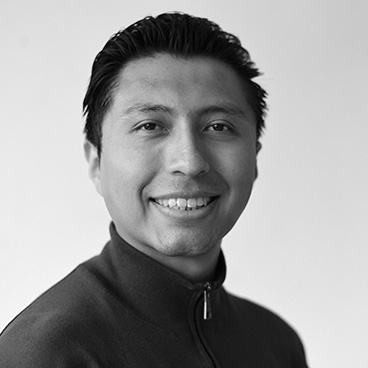
Joel Churquina
Joel Churquina was born in Bolivia in 1995. Even as a child, he wanted to do “something with media”. After a radio internship at the Xperticia station in La Paz, Bolivia, this desire became more concrete. At the same time, he realized that he was passionate about languages of all kinds – he was particularly fond of German. So he decided to pack his bags and emigrate to Germany. Here, he wants to study the language and culture even more intensively. His next goal? To become a professional in intercultural communication!
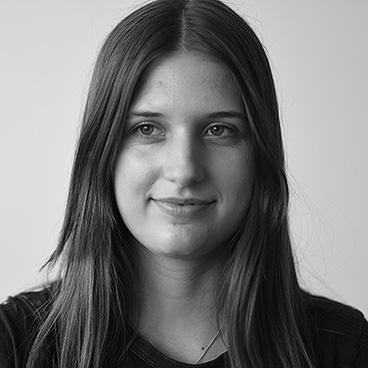
Frida Lemm
Frida Lemm was born in Kleve on the Lower Rhine in 2004 and spent her childhood in the countryside, where she loved to spend time in the stables. She recognized the potential of these experiences as “film material” at an early age. She invested her first savings in a waterproof digital camera. Since then, her fellow human beings can always expect to be involved in one of her current “productions”. She got to know the professional side of media production during a school internship. This internship further ignited her passion, which continues to this day.
Sarah Probst
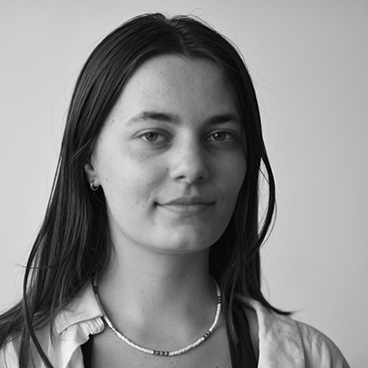
Sarah Probst was born in Bonn in 2005 and discovered her passion for animated films at an early age. She was particularly fascinated by the funny and factual stories on “Sendung mit der Maus”, which sparked her interest in technology and science. Her second passion is drawing. She uses this talent to depict complex topics in an understandable way, for example when planning media projects. Sarah prefers to relax by the sea – surfing, skating or capturing beautiful moments in vacation photos and drawings.
Lara Schulzky
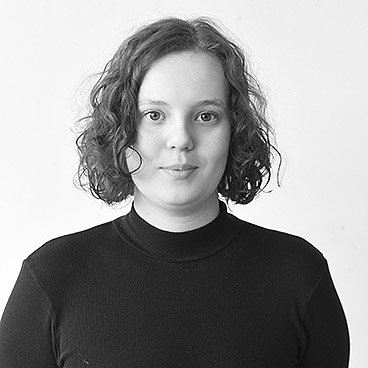
Lara Schulzky, born in Gladbeck in 2004, loves traveling and getting to know new cultures. While still at school, she spent several months as an exchange student in Norway. After graduating from high school, she moved to South Korea for a few weeks, where she attended a language school in Seoul and lived with a host family. She hardly knows silence because there is usually a podcast, music or an audio book playing. She also wants to pursue her curiosity and wide-ranging interests professionally. Journalism is a perfect fit.
Astrid Senger
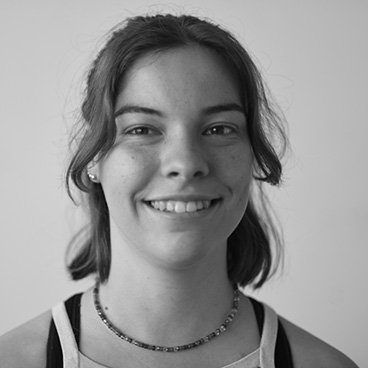
Astrid Senger, born in Mönchengladbach in 2003, was enthusiastic about film and photography from an early age. She made her first Playmobil videos in her childhood bedroom, which sparked her passion for media design. Consequently, she trained as a design assistant. She has since realized several film projects and is constantly expanding her practical knowledge. Her curiosity and critical mind drive her to constantly search for new topics and ideas.
Alexandra Suchan
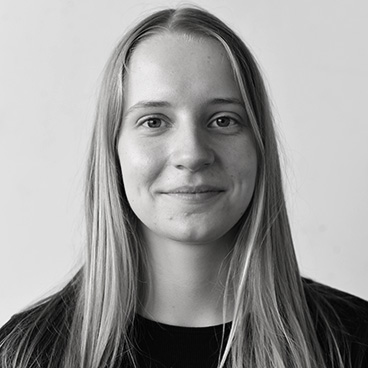
Alexandra Suchan, born in Sankt Augustin in 2002, began capturing special moments with her mother’s digital camera when she was just a child. Her second great passion is travel: During her school years, she participated in several exchange programs and, at age 15, spent a year abroad on a farm in Canada. After graduating from high school, she headed to Australia, where she worked as a construction worker in Tasmania—always with her camera in hand. Today, she knows that she wants to work professionally with a camera, preferably in nature and with animals.