
How Does the Agricultural Press Report on Innovations?
The agricultural sector is under pressure: it is expected to produce efficiently, sustainably and affordably on limited land. Research is intended to help find solutions to these societal expectations. But how do innovations make their way from the laboratory to the field? A study on agricultural media and the working methods of the agricultural press provides answers.
Students on the Master’s programme in Digital Communication and Media Innovations at Bonn-Rhein-Sieg University of Applied Sciences asked themselves whether innovations funded by EU research grants actually reach agricultural businesses in Germany in practice. To answer this question, they examined how agricultural media report on the research projects and interviewed agricultural journalists.
One of the key findings is that agricultural journalists regard innovations in agriculture as indispensable. Nevertheless, projects are only reported on if they involve solutions that are already suitable for practical use, if a concrete benefit for farmers is apparent, or if a corresponding development is foreseeable. For this reason, farmers play a central role in reporting as testimonials and, not infrequently, as experts providing context. It is striking that print media remain the focus of agricultural journalism – particularly in specialist reports and coverage of innovations.
The agricultural press plays an important role in informing farmers: in a market analysis by MAagrar and the Arbeitsgemeinschaft Organisationsgebundene Landpresse AOL in 2023, 90 per cent of respondents stated that an agricultural magazine (weekly or national magazine) is a very important or important source of information for their farm management. The so-called weekly newspapers – weekly multi-topic agricultural media – and national specialist magazines play just as important a role as the general press and contribute more to informing farmers than radio, TV or online media.
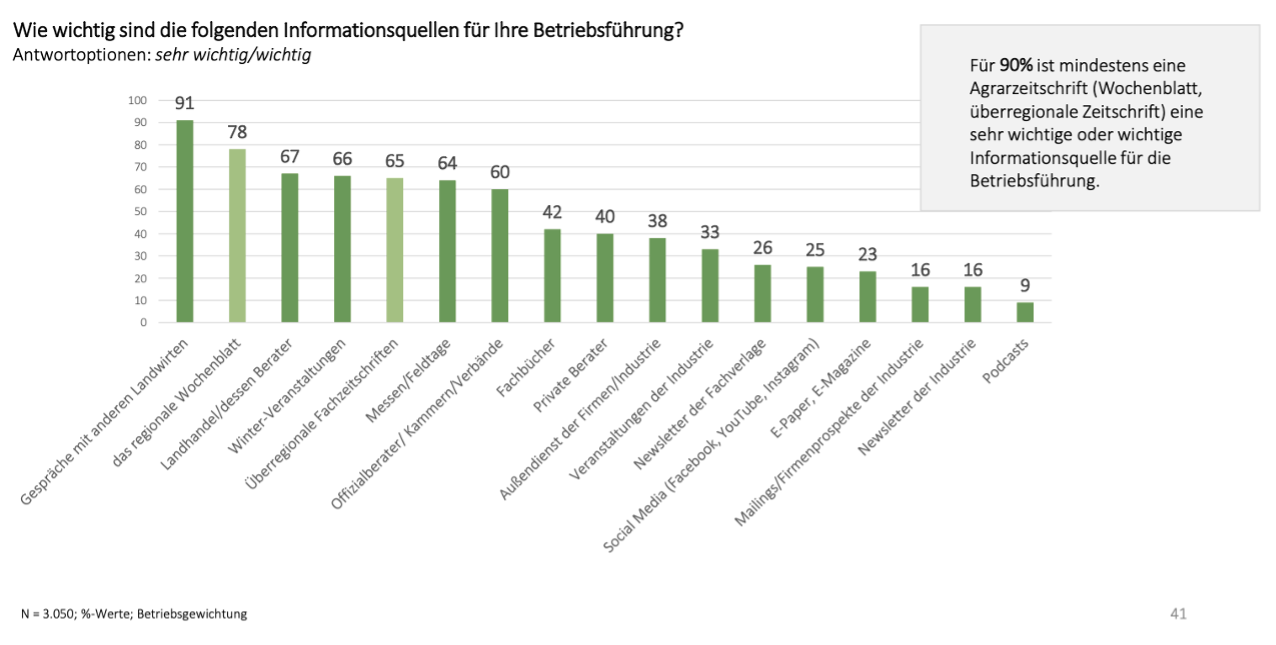
Information media for farmers (in descending order of importance), MAgrar and AOL study (2023), p. 41
Practical projects as a starting point
The study took as its starting point press releases about completed research projects whose results can be directly applied on farms, e.g. a new method for using hemp straw or a breed of turkey suitable for organic farming. When selecting the projects, the students focused on research and development initiatives funded by the Federal Office for Agriculture and Food. Four practical projects were selected, developed jointly by academia and industry, which aim to deliver sustainable, marketable solutions in the fields of animal husbandry, crop production and digitalisation. In addition to the four BLE-funded projects, agricultural journalism coverage of the Federal Ministry of Agriculture’s “Animal Welfare Billion” project was also analysed.
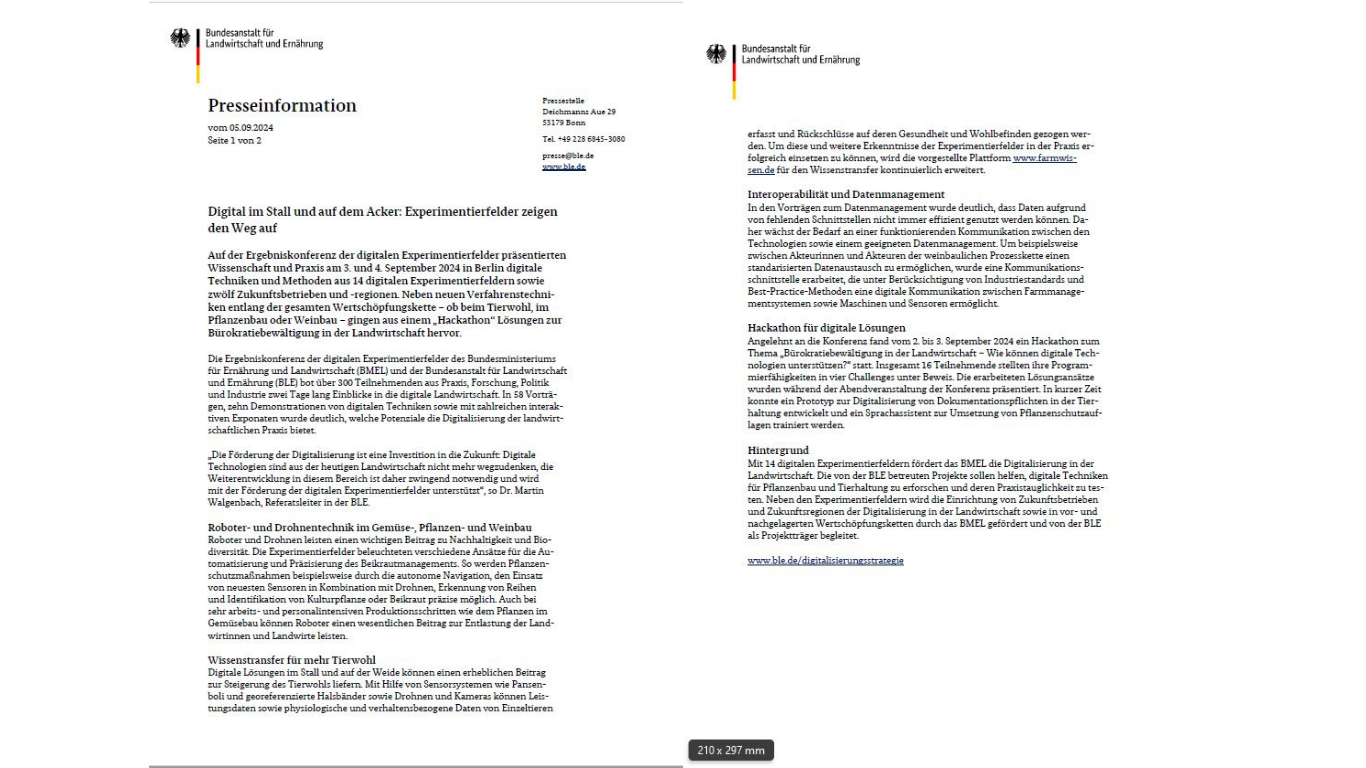
Example of a BLE press release on the digital experimental fields in crop production and animal husbandry
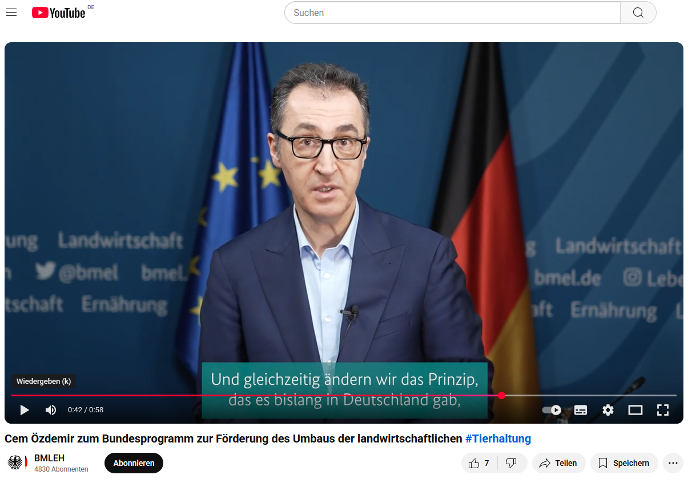
The Federal Ministry of Agriculture also provided information on the “Animal Welfare Billion” funding initiative via a YouTube statement by Agriculture Minister Cem Özdemir.
To collect the data, the Master’s students used a multi-stage process: first, they searched the Nexis specialist database, relevant specialist publishers, and conducted an advanced Google search, as well as looking on Instagram and YouTube, for agricultural journalism coverage of the five selected projects. In doing so, they came across online reports, a few social media posts and project videos on YouTube. All media were analysed with regard to the presentation of innovations, the sources used, the storytelling and the inclusion of farmers as testimonials. In a further step, the students conducted interviews with the authors.
Reports dominate, little social media, hardly any videos
The students found reports on all five projects in the online editions of traditional regional and national multi-topic print media. For three projects, coverage extended beyond the typical online articles to include corresponding social media posts.
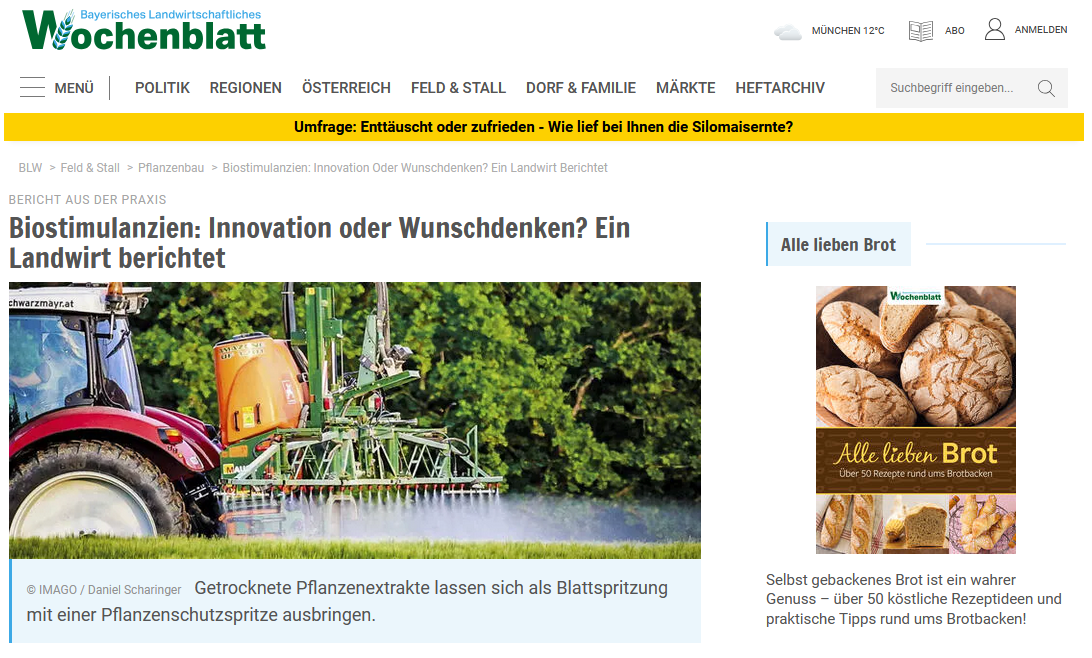
When it comes to reporting on innovations, traditional reports in print media still dominate. They are now also available online, but are mostly hidden behind paywalls. Here is a screenshot from the Bayerisches Wochenblatt.
A search for journalistic Instagram posts did not yield results for all projects. Scrolling through the Instagram feeds of agricultural media outlets, it was noticeable that, particularly in the case of weekly newspaper editorial teams, stock images depicting life and work on the farm dominate. Posts that can be linked to specific projects are rare. They usually link to an online article behind a paywall. The posts are predominantly images of farmers (single images or carousel posts) shown in their working environment and in the context of the innovation. Journalistic Reels on innovation topics were scarcely found.
In the project videos too – with the exception of the video message from the Federal Minister of Agriculture – the focus is on farmers, advisors and entrepreneurs. They present the innovation in their working environment, speak the language of practice and report on their experiences. The presentation of innovation topics in social media posts and project videos differs significantly from traditional reports in terms of visual appeal, emotional impact, storytelling and the stakeholders featured.
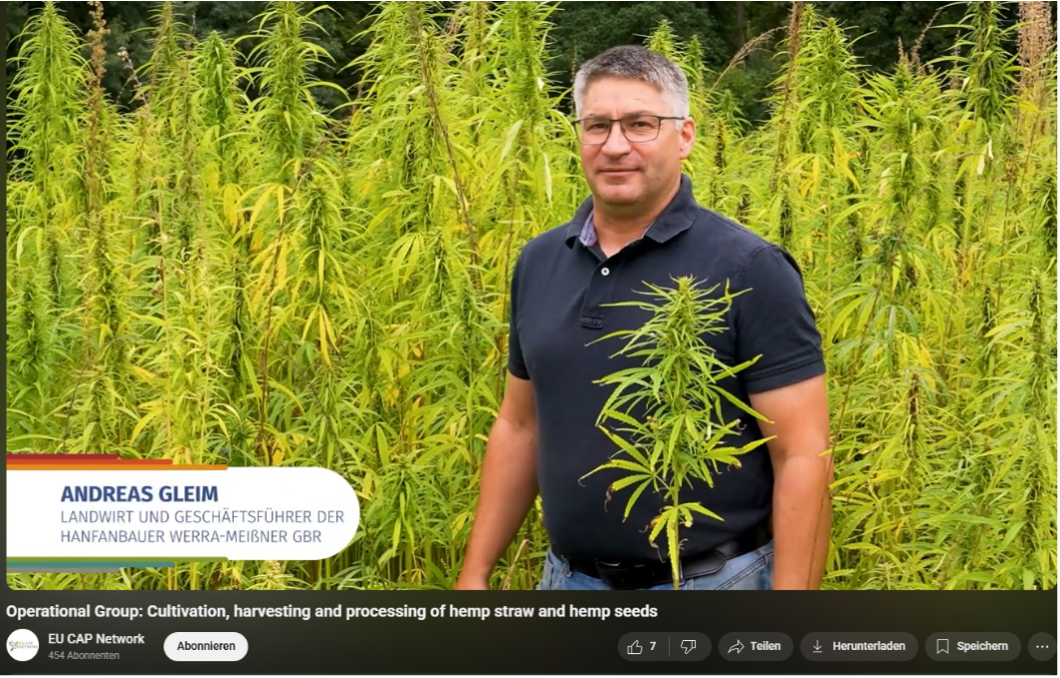
In the project video for the CAP Network’s hemp cultivation project, a farmer and managing director of Werra-Meissner GBR reports on experiences with new methods in hemp cultivation.
To better contextualise the findings from their research and media analysis, and to learn more about the needs of agricultural journalists when reporting on innovation, the students interviewed agricultural journalists. They selected authors of articles published in print editions of national and regional multi-topic agricultural media, including Agrarzeitung, das Landwirtschaftliche Wochenblatt, top agrar, Land&Forst and das Bayerische Landwirtschaftliche Wochenblatt
Innovations are regarded as “problem solvers”
From the perspective of the journalists surveyed, innovations are an important topic for their reporting because they are regarded as something “new” that is intended to solve problems in agriculture and enable change within the sector. This is reflected in the following quotes, which essentially convey the opinion of all respondents:
“(Innovations have) a very, very significant and, I would say, increasingly important role to play for the future, because agriculture is in quite a bit of a bind. Land is becoming scarcer, the population is growing, and demands on production are rising. At the same time, however, food must become cheaper.” (TA)
“For me, innovations are things that try to solve the current problems and challenges faced by farmers in some way.” (TA)
“Farmers are, of course, keen to look ahead and […] think about the future. […] Young farmers in particular are very keen to find innovative solutions to various problems.” (BW)
Technical developments such as digital tools, sensor technology or artificial intelligence are particularly often in the spotlight. Despite the great importance of innovations, not every innovation is reported on per se: whether from research or directly from farms – the decisive factor is that innovations have a tangible impact on practice:
“We report on an innovation if, in our assessment, it has the potential to be relevant to practice in some way.” (LW)
Networks, and farmers in particular, play an important role in assessing relevance:
“… Of course, we also decide this in consultation with the entire network we have. As an editor, you’re constantly in contact with associations, farmers and … (LW)
Topic selection and sources in agricultural reporting
Which innovation topics make it ‘into the magazine’ depends on various factors. On the one hand, expectations from politics, associations and funding projects influence the editorial agenda, with the influence of farmers’ associations being particularly noticeable when they are the owners of the publishing house. On the other hand, suggestions from the field, particularly from farmers, play an important role. Ultimately, it is the editorial team that decides whether to report on an innovation topic:
“That is decided on a case-by-case basis. …If it turns out that everyone says, ‘Oh, that’s just nonsense, it feels like it’s ages away in the future,’ then we’ll leave it for now. … “But what we do… if there are already pilot projects that aren’t quite ready for practical application yet, but where there’s a real drive for innovation and where projects are already underway, then we do publish them.” (LF)
Research projects that involve the agricultural sector have the best chance of being covered by agricultural media at an early stage. This applies in particular to regional media when farmers from their own catchment area are involved. If the innovation is relevant beyond the region, media from other regions or national media will also report on it; the decisive factor is the relevance to the respective target audience.
An editorial team member reports on a ‘Perspective’ section with focus topics. In this way, the editorial team keeps an eye on the major innovation topics:
“We … have … in our ‘Perspective’ section … an endless list of focus topics: these include, for example, topics on insects, smart farming, alternative sources of income, niches, crops and community-supported agriculture.” (TA)
“And I’ve really taken the ‘Perspective’ section to my heart, because there we showcase pioneers … farmers who were simply brave, perhaps even gave up one farm and dared to build a new one.” (TA)
An important source of research for many agricultural newspapers are meetings and events for farmers. On the ground, journalists can pick up on topics from presentations, make contacts and gather voices from the field. These provide an insight into different positions and priorities within the agricultural sector – and thus also into the interests of the readership. Press releases do not play an important role for all respondents.
“I go to a meeting in winter, for example the Forest Farmers’ Meeting, the District Farmers’ Day or the Machinery Ring, and that’s where I get the information … I don’t usually use press releases.” (BW)
“I take press releases and translate them, so to speak, for the farmers…” (TA)
For agricultural media, particularly those published by publishers in which farmers’ associations are shareholders or founders, representatives of the farmers’ associations are often the first points of contact during research. Der Bauernverband is the largest professional association representing farmers in Germany. It is an umbrella organisation comprising the regional farmers’ associations and other associations closely linked to agriculture. However, this proximity to the farmers’ associations was also viewed critically.
“Basically, with something like the hemp project, it’s interesting because it was carried out by the Hessian Farmers’ Association.” (LW)
“When you have a partnership with the farmers’ association, you are naturally also somewhat inclined to showcase the association’s innovations.” (AZ)
Other sources include scientific studies relevant to the target audience, as well as invitations from universities. Digital tools such as Google News, Google Alerts and filter services are also increasingly being used. Nevertheless, personal contacts – for example, for expert opinions or voices from the field – remain essential.
“There’s Google News, there are various filters (Google Alerts) you can set up, and there are various online sources … .” (LF)
“… It really is a lot easier through networking.” (LW)
Farmers play a central role
Farmers are key interviewees in journalistic reporting – not only as experts, but also as authentic voices from the field. They provide important insights into current developments, new technologies and the day-to-day challenges of agriculture. For many journalists, they are therefore an indispensable source – particularly when it comes to practical assessments or well-founded analyses.
“… It is very important to engage with farmers. … That way, you are … informed about the concerns and difficulties farmers face. … That is essential.” (BW)
“It is … the case across the entire sector … that most farmers are most likely to trust what another farmer tells them.” (LW)
“In principle, this involves having … an … awareness of the target group. … You have to engage in a lot of dialogue with farmers and hold background discussions in order to even know where the problems lie and where solutions might be needed.” (TA)
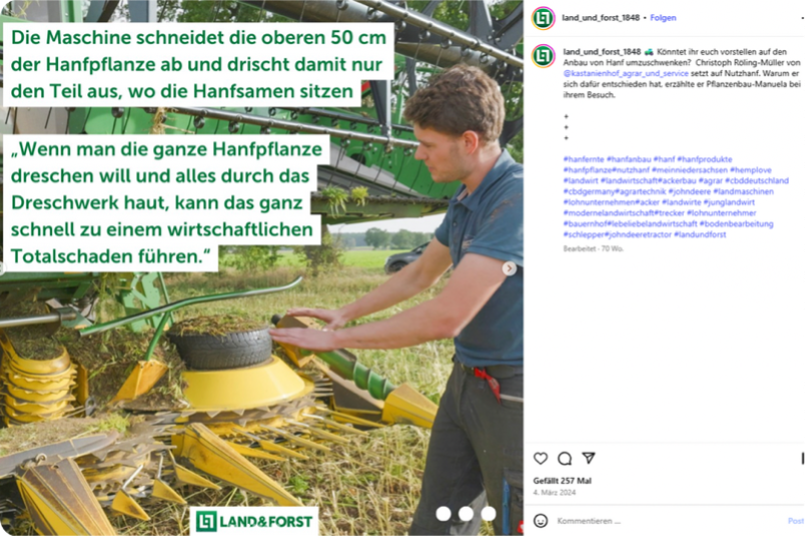
Farmer Christoph Röling-Müller demonstrates hemp processing on his farm, Posting Land und Forst, 04.03.2024
Farmers contribute not only information but also important insights to journalistic work. They draw attention to shortcomings, raise new issues and prompt further investigation. At the same time, they offer critical commentary on the reporting – through praise, dissent or additional perspectives.
“It happens time and again that you go to events, … are approached … and told: ‘What have you written there? It’s not relevant to real-world practice at all.’“
(LW)
“… We do occasionally get a letter to the editor saying: ‘Listen, I’ve got something really great going on here at my farm – wouldn’t you like to report on it?’” (LF)
“I also use the target audience (farmers) as a sort of corrective. ” (TA)
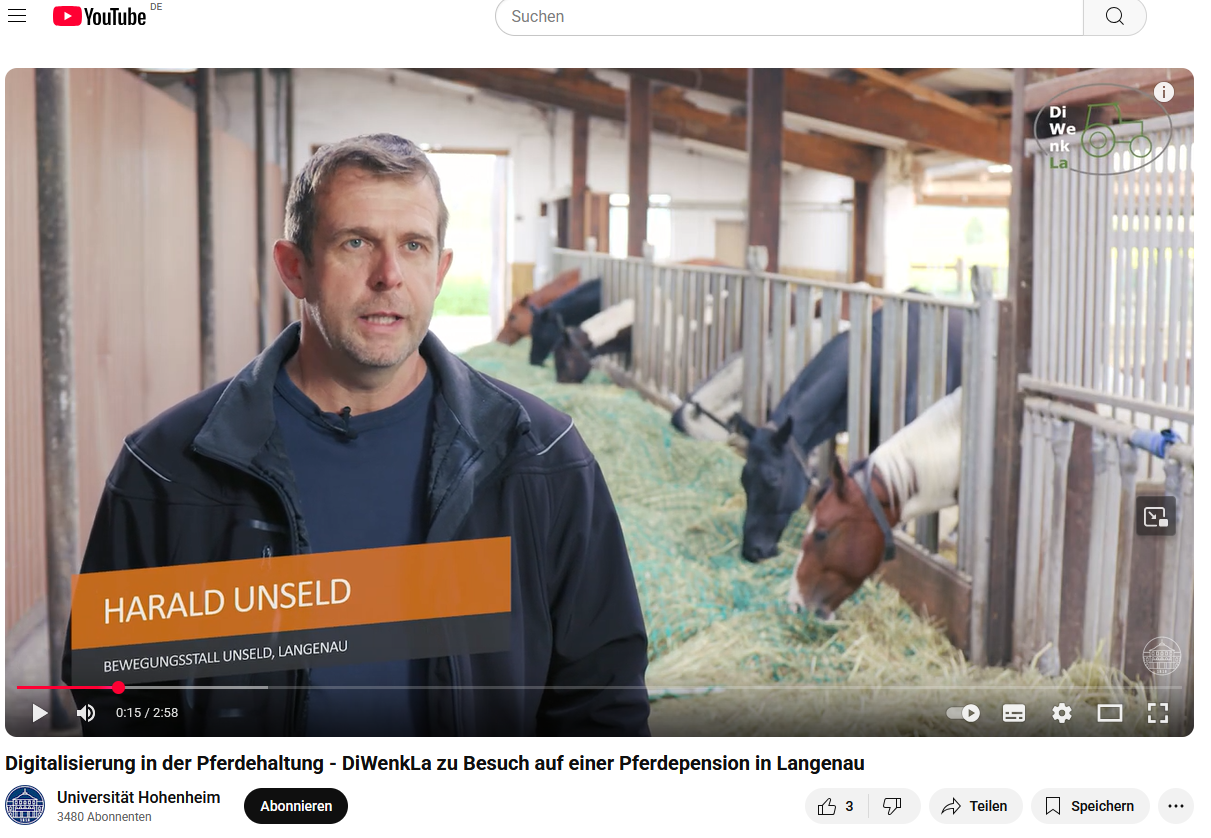
The experiences of fellow professionals are particularly convincing for farmers – project videos also make use of this. Here, farmer Harald Unseld from Langenau reports on digitalisation in the horse stable.
Requirements for reporting
The agricultural journalists interviewed apply generally accepted journalistic quality criteria to their work: reports on innovations in agriculture should be presented in a way that is understandable, solution-oriented and practical. The content should be technically and socially relevant, based on diverse sources and incorporate different perspectives.
“Towards the end of the text, I try … to let project participants have their say or mention institutions … (or) provide background on the project.” (TA)
The interviewees consider storytelling important for conveying the content more effectively. A report on innovations often begins by presenting the problem and ends with the solution implemented on the farm.
“Of course, we try …, when we … do reports, to … include a story.” (LW)
“I usually start the text by setting out the problem …, so that the farmers become a bit curious and think ‘Ah yes, okay. I know that problem’, and then I usually outline what the solution might look like.” (TA)
Factual, matter-of-fact language, clear structure, many design elements
Authors of agricultural journalism texts on innovation write in a factual, matter-of-fact style and avoid flowery or promotional language. Technical scientific jargon is also avoided; the aim is to translate information of interest to farmers into understandable language.
“We also deliberately avoid using sensational headlines. Of course, sometimes you’d like to spice things up a bit, but that gets edited out, so our headlines are generally quite neutral.” (AZ)
“Well, I always sum it up by saying that the language is precise, but very simple, very easy to understand, yet lively.” (TA)
Images and graphics play an important role in conveying information. Furthermore, articles should be well-structured and include subheadings. Overall, the rule is: editors must present their content as effectively as possible in both images and text using limited resources – but they cannot always realise their full potential in doing so. Sometimes the authors take the photographs themselves.
“Well, I use quotes, highlighted quotes. I use info boxes, i.e. text boxes, and then people boxes, where you can somehow highlight a person who appears in or is described in the article. … We work very heavily with images. … Personally, I like to use timelines. … You can … present that really well with a timeline if you have a very good graphic designer. … Headings, of course, you can also format those in a special way. … Badges, … with little images like that.” (AZ)
“Well, it’s mostly stock material or images taken by the authors themselves.” (LW)
Social media strategies still need to be developed
According to the interviewees, many editorial teams lack the time and resources to incorporate supplementary videos or films into online articles. This bottleneck also affects the use of social media for disseminating content.
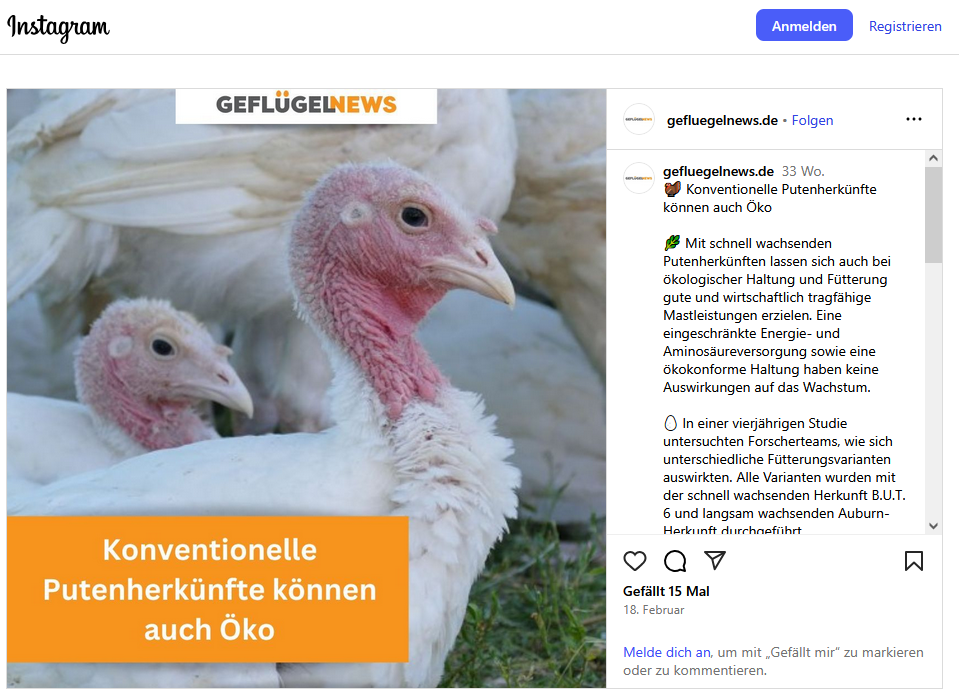
Editorial teams often lack time and resources. Here, the BLE press photo was used as an eye-catcher for the post accompanying the press release on a suitable turkey breed.
Although social media is regarded by those interviewed as an important channel for the younger target group, there is a lack of time, staff and expertise for platform-specific formats such as TikTok videos or Instagram Reels. The challenge: innovations must be communicated in a way that is understandable and appealing within a few seconds, without losing depth. It is also noted that social media work must always be highly topical.
“Actually, it’s the social media channels and the internet that we really need to focus on for younger target groups. … And… social media is, after all, something where you have to be active every day to stay relevant.” (LW)
“You can tell that we don’t have anyone dedicated solely to social media and that there isn’t yet a specific, ready-made strategy.” (LW)
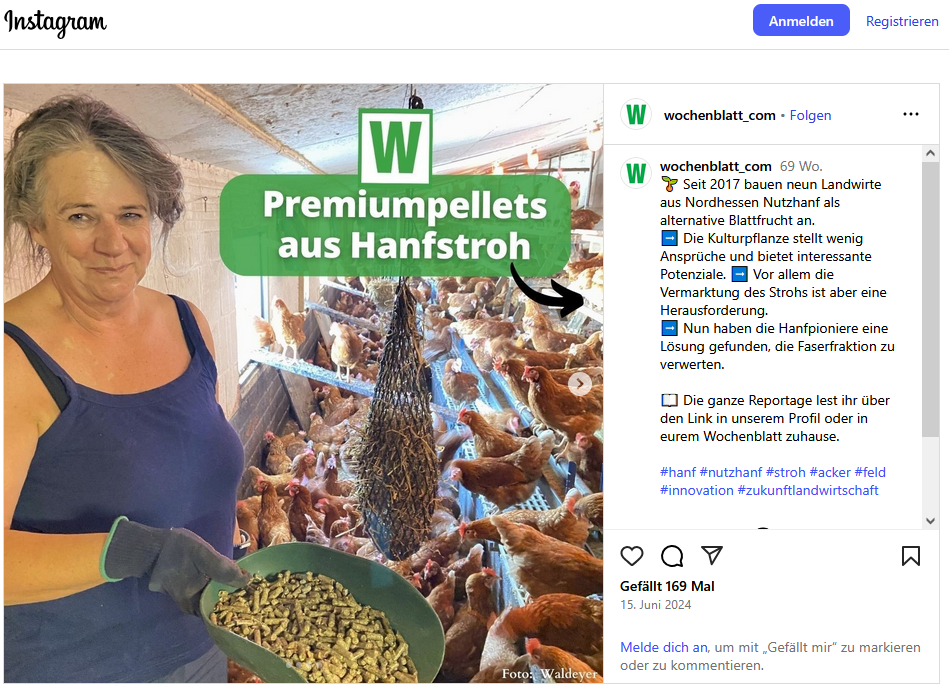
One of the few Instagram posts that ties in with one of the innovation projects examined and does not merely link to an online article (Premium pellets made from hemp straw, Wochenblatt Land&Forst, 15 June 2024)
According to the interviews, two media outlets have a dedicated team or a designated person who deals exclusively with this area.
“We have a presence on Facebook, Instagram and the WhatsApp channel. This is managed by a colleague who specifically looks after the digital social media channels.” (LF)
“We have social media channels that are managed by a separate social media team.” (TA)
The interviewees believe that strategies need to be developed and clear responsibilities assigned in order to increase social media presence. Agricultural journalists see the topics themselves as a further challenge for social media. The agricultural media’s thematic focus is often on political, frequently complex technical content that is difficult to translate into a social media format. A particular challenge here is conveying the topic in depth despite the fast-paced nature of the format, whilst at the same time ensuring the post remains short, engaging and entertaining.
“We also have many followers on social media who are simply interested in agriculture, … because they want to know where their food comes from. … And that’s where topics from the ‘Perspectives’ section are featured more. Beyond that, it’s mainly political topics that are covered, rather than such complex articles.” (TA)
The study on innovation reporting in digital agricultural media yielded the following key findings :
Understanding and significance of innovations
• Innovation is mostly understood as a technical innovation (e.g. machinery, processes, digitalisation, AI)
• Innovations are intended to provide answers to the challenges of agricultural practice and solve problems, and they should be transferable to the wider agricultural sector
• Innovations are intended to make agriculture more resilient, contribute to increased efficiency, and support food security, sustainability and animal welfare.
• Innovations play an important role, but they are not the sole driver of change – practical relevance determines their significance.
Topic selection and sources
• Agricultural journalists select topics primarily based on suggestions from farmers, networking, meetings, conferences and press releases.
• Research projects are only covered if they appear practical or are of regional/political relevance.
• The editorial team has the final say, although input from practitioners is highly valued.
• Studies or scientific findings are rarely the sole basis for reporting, but rather serve as a supplementary source in reporting.
Role and portrayal of farmers in reporting
• Farmers are a key source, guide, supervisory body and target audience – and in some cases are themselves active as journalists
• Voices from the field (quotes, examples, profiles) enhance the credibility and value of the articles.
• Farmers are frequently portrayed as drivers and pioneers of innovation
• Farmers and agricultural businesses are portrayed positively in the agricultural media; care is taken to use appealing images
Requirements for reporting
• High standards of professionalism and technical depth
• A problem- and solution-oriented approach is crucial, without coming across as patronising
• Balance: Different opinions, farm examples and perspectives (practice, research, politics) should be highlighted. Affiliation with associations can limit objectivity
• Simple and understandable language (‘farm speak’ rather than academic jargon)
Channels and formats
• Print remains central; online serves as a supplement (e.g. more detailed presentations, videos, reports). Cross-media is perceived as relevant.
• Digital channels are gaining importance for reaching younger target groups (e.g. agricultural students).
• Short videos, visual material and practical reports with storytelling elements are used in some instances, but are limited due to resource constraints.
• Social media has been little used to date; there is a lack of strategies, responsibility and resources (high time and staffing pressures)
The Master’s project
The results presented are based on a study conducted as part of a Master’s project within the “Digital Communication and Media Innovation” degree programme:https://www.h-brs.de/de/iwk/studienangebot/master/digitale-kommunikation-und-medieninnovation.
Supervisor: Prof. Dr Katharina Seuser
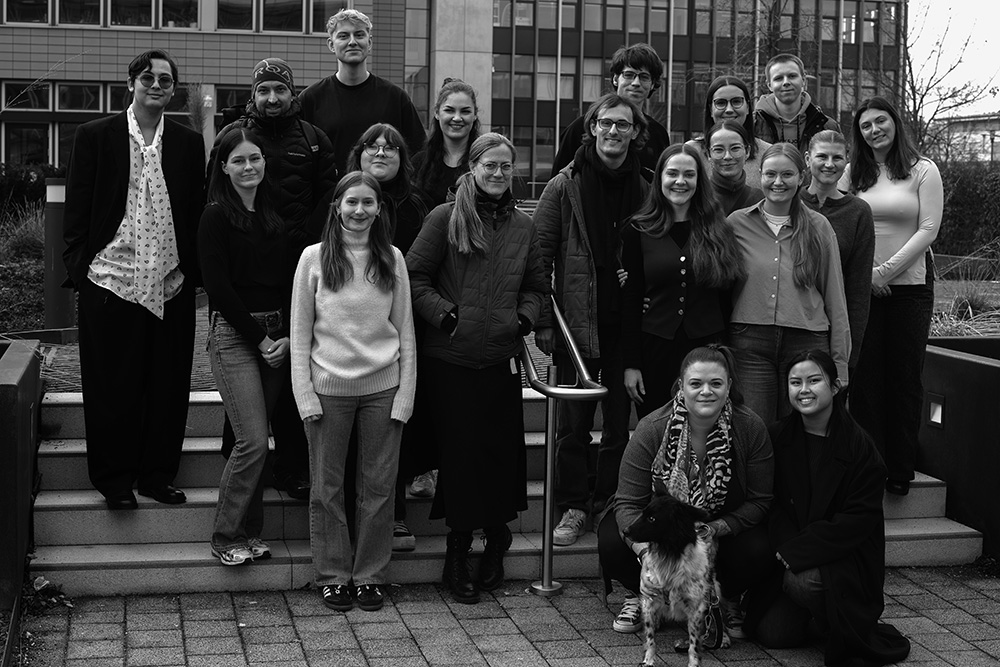
The second cohort of the Master’s programme in ‘Digital Communication and Media Innovation’
Share this article via: